
wquestions-mcp
Lets you model any domain (spa, barbershop, clinic, etc.) using 7 fixed axes and query it via natural language, with no per-domain schema required.
README
wquestions-mcp
Model any domain in 7 questions.
An MCP server that lets Claude Desktop (or any MCP client) build and query a knowledge model of anything — a spa, a barbershop, a clinic, a bank — using one fixed set of tools. No per-domain schema to write, ever.
The problem
Every domain today gets its own bespoke ontology or database schema: a CRM schema for sales, a clinical model for a clinic, a different one again for a bank or a taxi dispatcher. None of it transfers between domains, and none of it was designed for an LLM to reason over — each new domain means new modeling work before an AI can even start answering questions about it.
WQuestions replaces all of that with a single fixed index: 7 axes that any fact, in any domain, answers. Model a domain by asserting facts on those 7 axes; query it the same way no matter what the domain is.
The 7 axes
| Axis | Question | Holds |
|---|---|---|
| Q | who | agents |
| O | what | objects, and reified situations (facts treated as things) |
| L | where | places |
| T | when | time points and intervals |
| N | how much | magnitudes with a unit |
| K | which / what kind | atemporal categories, types, states |
| M | how | the predicates that connect Q/O/L/T/N/K to each other — structural, not a value axis |
Quickstart
Add this to your Claude Desktop config (claude_desktop_config.json) and
restart Claude Desktop:
{
  "mcpServers": {
    "wquestions": {
      "command": "uvx",
      "args": ["wquestions-mcp"]
    }
  }
}
Prefer to run from source? Clone this repo and, from the repo root,
pip install -e . into a virtualenv (the engine is bundled — no other
package needed). Then point command/args at that venv's wquestions-mcp
script (e.g. command: ".../.venv/bin/wquestions-mcp", args: []) instead
of uvx.
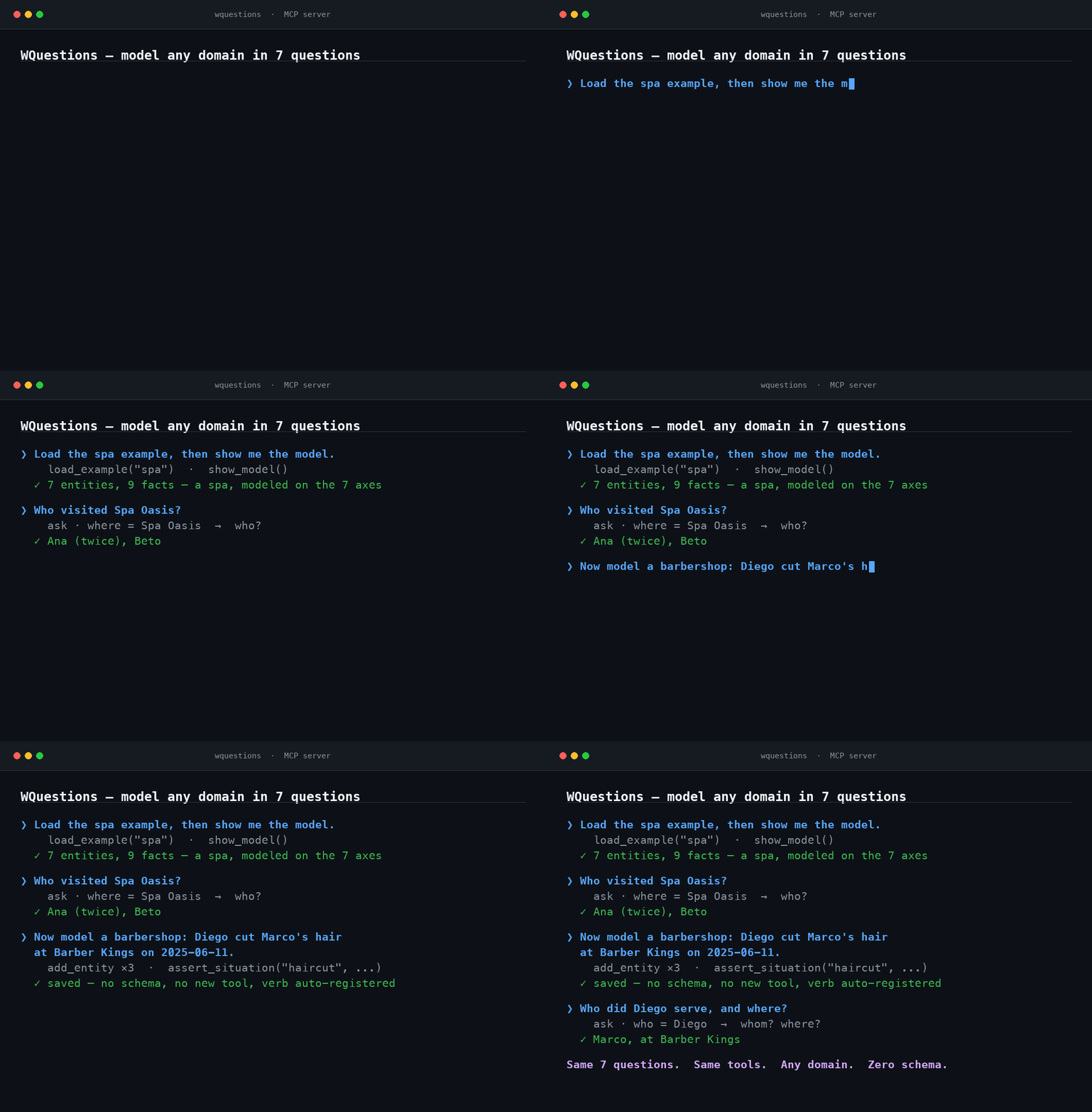
Then ask Claude: "Load the spa example, then show me the model." See
DEMO.md for the full 30-second walkthrough.
Tools
| Tool | Does |
|---|---|
list_axes |
Describe the 7 axes |
list_roles |
List canonical roles (who/what/where/... connectors), typed by domain and range |
add_entity |
Create an individual on a value axis (Q, O, L, T, N, K) |
define_verb |
Register a situation type and its roles — optional, assert_situation auto-registers unknown verbs |
assert_situation |
Assert a fact: reify a situation and attach its roles |
ask |
Query by projection — fix some roles, ask for others, optionally as of a point in time |
show_model |
Dump the current universe: every entity and fact |
load_example |
Load a prebuilt demo universe (spa) to try queries instantly |
reset |
Clear the model and start a fresh universe |
How it works
The LLM client does the natural-language-to-structure step: it reads "Diego
cut Marco's hair at Barber Kings on 2025-06-11" and turns it into
role-labeled arguments (agente: diego, paciente: marco, lugar_de: barber_kings). The server never parses English — it takes those roles,
validates them against the 7-axis model, and runs ingest and query over the
wq engine. Same engine, same 9 tools, whether the domain behind them is a
spa or a barbershop.
Further reading
The 7-axis model — why it's fixed, what each axis actually commits to, and how it holds up once you push on it — is worked out in full in WQuestions, the book this project comes from (Spanish). Start with Chapter 8, El espacio multidimensional for the axis model itself, or the table of contents.
Recommended Servers

playwright-mcp
A Model Context Protocol server that enables LLMs to interact with web pages through structured accessibility snapshots without requiring vision models or screenshots.

Magic Component Platform (MCP)
An AI-powered tool that generates modern UI components from natural language descriptions, integrating with popular IDEs to streamline UI development workflow.

Audiense Insights MCP Server
Enables interaction with Audiense Insights accounts via the Model Context Protocol, facilitating the extraction and analysis of marketing insights and audience data including demographics, behavior, and influencer engagement.

VeyraX MCP
Single MCP tool to connect all your favorite tools: Gmail, Calendar and 40 more.

graphlit-mcp-server
The Model Context Protocol (MCP) Server enables integration between MCP clients and the Graphlit service. Ingest anything from Slack to Gmail to podcast feeds, in addition to web crawling, into a Graphlit project - and then retrieve relevant contents from the MCP client.

Kagi MCP Server
An MCP server that integrates Kagi search capabilities with Claude AI, enabling Claude to perform real-time web searches when answering questions that require up-to-date information.

E2B
Using MCP to run code via e2b.

Neon Database
MCP server for interacting with Neon Management API and databases

Exa Search
A Model Context Protocol (MCP) server lets AI assistants like Claude use the Exa AI Search API for web searches. This setup allows AI models to get real-time web information in a safe and controlled way.

Qdrant Server
This repository is an example of how to create a MCP server for Qdrant, a vector search engine.