
web-fetch-mcp
A web-fetch MCP server for LLM agents that fetches pages with an escalation ladder through different engines, raising FetchBlocked instead of returning blocked content.
README
web-fetch-mcp




A web-fetch MCP server for LLM agents that
fails honestly — it raises FetchBlocked instead of silently handing your model
a CAPTCHA or login page as if it were the article.
- PyPI: https://pypi.org/project/web-fetch-mcp/
- Source: https://github.com/Dutta-SD/web-fetch-mcp
- Install:
pip install web-fetch-mcp
Naive fetchers poison an agent's context: when a site returns a JavaScript
interstitial or a login wall with HTTP 200, the agent reads the challenge page as
if it were content and reasons from garbage. web-fetch-mcp detects that and
either escalates to a stronger strategy or fails loudly.
Status: early / alpha. The escalation logic and helpers are unit-tested, but real-world bypass rates are not yet benchmarked — see
assets/benchmarks.mdand the roadmap inTODO.md.
How it works
A cheapest-first escalation ladder. Each tier targets a different layer of bot-detection, and the server only pays for the expensive ones when it has to:
| Tier | Engine | Targets | Speed |
|---|---|---|---|
| 1 | curl_cffi (Chrome TLS/HTTP2 fingerprint) |
TLS (JA3/JA4) + HTTP/2 fingerprinting | ~500 ms |
| 2 | Patchright (real headful Chrome) | JavaScript fingerprinting; renders SPAs | ~1–3 s |
| 3 | nodriver (custom CDP) | automation-protocol (CDP) detection | ~2–4 s |
Every tier's output is checked for hard blocks (403/429/503) and soft
blocks (HTTP-200 challenge or login bodies served in place of content).
Transient failures retry with exponential backoff + jitter (honoring
Retry-After) before escalating. If everything is blocked, it raises
FetchBlocked with a remedy hint — it never returns a block page as content.
Escalation path (mode="auto")
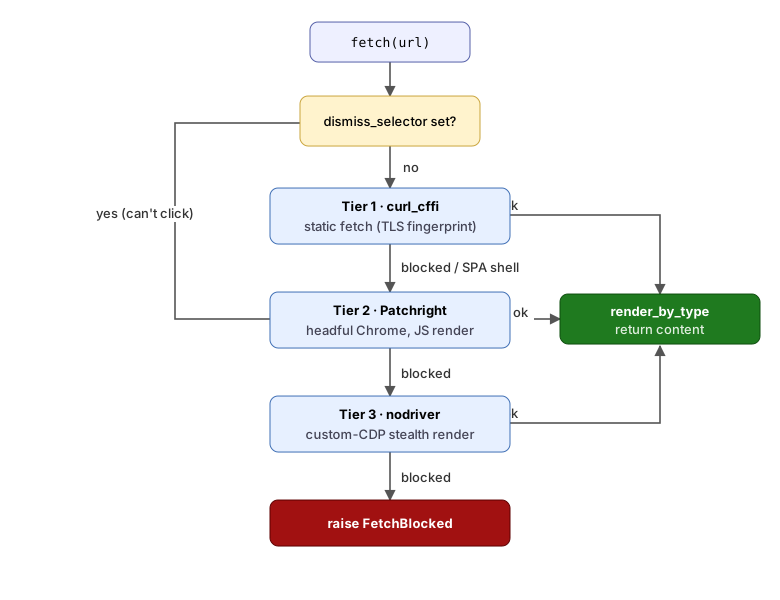
Each tier runs through with_retry (exponential backoff + jitter, honoring
Retry-After) before the chain escalates. Tier 1 must clear the strict check
(not blocked and not an unrendered SPA shell); Tiers 2–3 only need to be
not-blocked. The single-tier modes (static/dynamic/stealth) run exactly one
box and skip the chain.
Tools
fetch— retrieve a page asmarkdown/text/html/article(main-content extraction via trafilatura). Non-HTML URLs are auto-handled: JSON is pretty-printed, PDFs are text-extracted, images return a note to usescreenshot.screenshot— render a page in real Chrome and return a PNG.
Architecture
A layered package (src/web_fetch_mcp/), dependencies pointing inward:
controller  (FastMCP tools, lifespan)        controller/app.py
   -> service   (retry decorator, strategy registry, escalation, facade)
        -> accessor  (curl_cffi / Patchright / nodriver, BrowserManager)
             -> core   (models, config, detection, rendering, proxy, backoff)
- Strategy — the three tiers are interchangeable
async (request) -> FetchResultcallables in a registry (service/strategies.py). - Chain of Responsibility (intent) —
automode walks the tiers cheapest-first, escalating until one yields usable content (service/escalation.py). - Decorator —
with_retryadds exponential-backoff + Retry-After to any tier (service/retry.py), hand-rolled on the stdlib (notenacity). - Manager —
BrowserManagerowns one reused Chromium and closes it on the FastMCP lifespan shutdown (accessor/browser.py).
Quickstart
uv sync
uv pip install -e .        # installs the `web-fetch-mcp` console command
web-fetch-mcp              # run the stdio MCP server
Register it with any MCP-compatible client as a stdio server that runs the
web-fetch-mcp command (or python -m web_fetch_mcp.controller.app).
fetch("https://example.com/article", output="article")   # clean main content
fetch("https://api.site/data.json")                       # pretty-printed JSON
fetch("https://spa.example.com", mode="dynamic")          # force a JS render
Responsible use
This tool is for fetching content you are authorized to access. You are
solely responsible for complying with each site's Terms of Service, robots.txt,
and applicable law. It honors Retry-After and backs off by default; please
rate-limit responsibly. It does not solve CAPTCHAs or bypass authentication
you do not hold. Provided as-is, without warranty.
License
Recommended Servers

playwright-mcp
A Model Context Protocol server that enables LLMs to interact with web pages through structured accessibility snapshots without requiring vision models or screenshots.

Magic Component Platform (MCP)
An AI-powered tool that generates modern UI components from natural language descriptions, integrating with popular IDEs to streamline UI development workflow.

Audiense Insights MCP Server
Enables interaction with Audiense Insights accounts via the Model Context Protocol, facilitating the extraction and analysis of marketing insights and audience data including demographics, behavior, and influencer engagement.

VeyraX MCP
Single MCP tool to connect all your favorite tools: Gmail, Calendar and 40 more.

graphlit-mcp-server
The Model Context Protocol (MCP) Server enables integration between MCP clients and the Graphlit service. Ingest anything from Slack to Gmail to podcast feeds, in addition to web crawling, into a Graphlit project - and then retrieve relevant contents from the MCP client.

Kagi MCP Server
An MCP server that integrates Kagi search capabilities with Claude AI, enabling Claude to perform real-time web searches when answering questions that require up-to-date information.

E2B
Using MCP to run code via e2b.

Neon Database
MCP server for interacting with Neon Management API and databases

Exa Search
A Model Context Protocol (MCP) server lets AI assistants like Claude use the Exa AI Search API for web searches. This setup allows AI models to get real-time web information in a safe and controlled way.

Qdrant Server
This repository is an example of how to create a MCP server for Qdrant, a vector search engine.