
repogrammar_context
A read-only MCP tool that provides local-first, source-backed repository context for coding agents, returning metadata and a bounded read plan without requiring full file reads.
README
RepoGrammar
Local-first, source-backed repository context for coding agents.
Coding agents repeatedly read the same files to rediscover how a repository
implements routes, fixtures, models, and data access. RepoGrammar builds a
compact map of those implementation-pattern families before an agent reads
source broadly. It returns metadata and a hash-checked read plan when evidence
is strong, and a typed UNKNOWN instead of guessing when it is not.
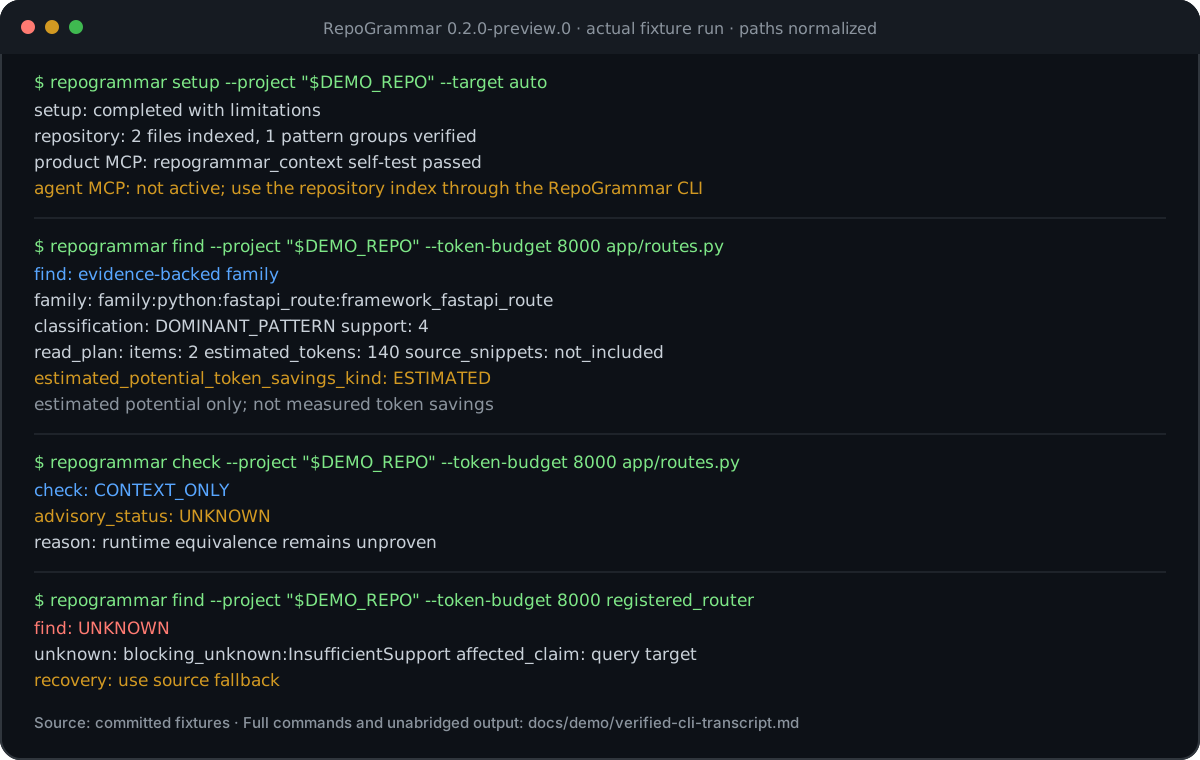
This is an audited excerpt from a real 0.2.0-preview.0 CLI run against
committed Python fixtures. Paths were normalized for display; the
commands and transcript are
reproducible from this checkout.
Install
Stable channel — verify the exact version
Availability is decided by the exact 0.2.2 publication, not by the
contents of this README. Verify both registries and the complete npm channel
mapping before using the no-build path:
npm view @sioyooo/repogrammar@0.2.2 version
npm view @sioyooo/repogrammar dist-tags --json
curl -fsSI https://github.com/SioYooo/RepoGrammar/releases/download/v0.2.2/install.sh.sha256
Continue only when the exact-version and GitHub checks succeed and the dist-tag
object contains exactly "latest":"0.2.2" and
"preview":"0.2.0-preview.0". Then run the pinned stable-channel release:
npx @sioyooo/repogrammar@0.2.2 setup --project /path/to/your/repo --target auto
After all three checks succeed, unversioned npx @sioyooo/repogrammar
resolves the same 0.2.2 package through npm latest. Use the exact version
for reproducible automation. The separate @preview dist-tag remains on
0.2.0-preview.0; publishing stable must not rewrite that historical package.
If any check fails, use the contributor/dogfood path, which builds once from source. The complete publication gate is in the stable release checklist.
git clone https://github.com/SioYooo/RepoGrammar.git
cd RepoGrammar
cargo build --release
bash src/install/repogrammar-install.sh --install-cli-only --from-source --yes
repogrammar version
The installed command needs Python 3.10 or newer (python3) for the bounded
Python analyzer. It does not need Node.js, npm, Docker, a local model, an
OpenAI API key, or a cloud API.
From setup to trustworthy context
Run setup inside the repository you want to analyze. It reviews one plan, initializes and indexes the repository, wires a detected Codex or Claude Code integration when ownership is safe, starts auto-sync by default, and runs a read-only product MCP self-test:
cd /path/to/your/repo
repogrammar setup --target auto

# Ask for a source-backed family and a bounded read plan.
repogrammar find --project . --token-budget 8000 app/routes.py

# Conformance remains advisory when runtime equivalence is unproven.
repogrammar check --project . --token-budget 8000 app/routes.py
The captured demo also asks for a target that static evidence cannot resolve:
repogrammar find --project . --token-budget 8000 registered_router
It returns UNKNOWN, identifies InsufficientSupport, and recommends source
fallback. That is a successful safety decision, not a failed query. Use the
fixture-backed walkthrough to reproduce
the exact find → check → UNKNOWN path.
How it works
RepoGrammar ships a pattern-family-first CLI and one read-only MCP tool,
repogrammar_context.
- Discover candidates locally. Language adapters and bounded semantic workers extract source-backed structural facts without executing the target repository.
- Require compatible support. Tree-sitter proposes candidates; it is not treated as a semantic oracle. Family claims require compatible exact-anchor evidence.
- Return metadata first. Results include repo-relative evidence, hashes, byte and line ranges, variation/exception coverage, and a minimal read plan. Source snippets are opt-in.
- Abstain by type. Stale, ambiguous, dynamic, unsupported, or insufficient
evidence becomes
UNKNOWNorPARTIAL_CONTEXT, with a recovery action. - Stay local and fresh. The active SQLite index lives under
.repogrammar/; explicit sync and auto-sync keep repository evidence current.
The Rust implementation follows a dependency-inverted
core → ports → application → adapters → interfaces architecture. See the
architecture overview and
MCP contract.
Support and limitations
| Language | Current evidence boundary |
|---|---|
| Python — FastAPI, pytest, Pydantic, SQLAlchemy | Bounded framework-family context, not full Python semantics |
| TypeScript / JavaScript — Express, Jest/Vitest, Next.js, Fastify, Prisma, Drizzle | Conservative exact-anchor preview |
| Java/Spring, C#, C/C++ | Structural preview; no runtime/build-system equivalence claim |
| Rust | Internal self-dogfood; no general Rust semantic-analysis claim |
| Go, PHP, Ruby, Swift | File discovery only; not analyzed or supported yet |
RepoGrammar 0.2.2 is the first published stable-channel pre-1.0 release. Its
MCP API and non-Python analyzers remain experimental; this is not a 1.0
API-stability or production-readiness claim. RepoGrammar is not a sound static
analyzer and does not replace source inspection.
estimated_potential_token_savings is an estimated local read-displacement
diagnostic—not measured savings or a causal claim. Measured savings require a
controlled before/after study; the current
limitations keep that boundary explicit.
macOS and Linux are the current supported platforms. Windows is not fully supported because its local index lifecycle still needs platform proof; no Windows release support is claimed.
Codex and GPT 5.6 Usage
RepoGrammar asks whether coding agents can read less repository source without becoming more confident than the evidence permits. OpenAI Build Week is a launch milestone, not the product boundary: RepoGrammar is being built as an ongoing local developer tool for coding-agent workflows.
The implementation used a human-directed GPT-5.6 workflow:
- ChatGPT (GPT-5.6) helped turn the maintainer's product direction into plans and reviewed each completed slice.
- Codex (GPT-5.6) implemented and tested Rust modules, language adapters, CLI behavior, release tooling, and documentation against repository gates.
- The human maintainer owns architecture, scope, evidence policy, review, and every merge. Commits use only the maintainer's identity.
Repository guardrails keep that collaboration auditable: the mirrored
AGENTS.md / CLAUDE.md contract requires scoped changes, tests and docs in
the same commit, no target-repository code execution, and typed UNKNOWN
instead of unsupported claims. The reusable
demo script and
launch kit contain the Build Week submission
copy without turning the README into a competition-only landing page.
License
RepoGrammar is licensed under the MIT License.
Recommended Servers

playwright-mcp
A Model Context Protocol server that enables LLMs to interact with web pages through structured accessibility snapshots without requiring vision models or screenshots.

Magic Component Platform (MCP)
An AI-powered tool that generates modern UI components from natural language descriptions, integrating with popular IDEs to streamline UI development workflow.

Audiense Insights MCP Server
Enables interaction with Audiense Insights accounts via the Model Context Protocol, facilitating the extraction and analysis of marketing insights and audience data including demographics, behavior, and influencer engagement.

VeyraX MCP
Single MCP tool to connect all your favorite tools: Gmail, Calendar and 40 more.

graphlit-mcp-server
The Model Context Protocol (MCP) Server enables integration between MCP clients and the Graphlit service. Ingest anything from Slack to Gmail to podcast feeds, in addition to web crawling, into a Graphlit project - and then retrieve relevant contents from the MCP client.

Kagi MCP Server
An MCP server that integrates Kagi search capabilities with Claude AI, enabling Claude to perform real-time web searches when answering questions that require up-to-date information.

E2B
Using MCP to run code via e2b.

Neon Database
MCP server for interacting with Neon Management API and databases

Exa Search
A Model Context Protocol (MCP) server lets AI assistants like Claude use the Exa AI Search API for web searches. This setup allows AI models to get real-time web information in a safe and controlled way.

Qdrant Server
This repository is an example of how to create a MCP server for Qdrant, a vector search engine.