
price-watch
A dated log of SaaS price changes across 494 tools: old price, new price and verification date for every move, plus category-level pulse and the biggest recorded increases.
README
price-watch
<div align="center">
</div>





@ the log, two real entries

  surfshark / Starter          vpn            2026-05-30
- $2.49
+ $15.45

  bluehost / Basic             cloud-hosting  2026-07-06
- $1.99
+ $3.99
That first row is a 520 percent jump on an intro rate that quietly expired. Nobody mails you about these. This MCP server hands an assistant the reviewed log of every move like it, so "did this get more expensive" stops being a guess.
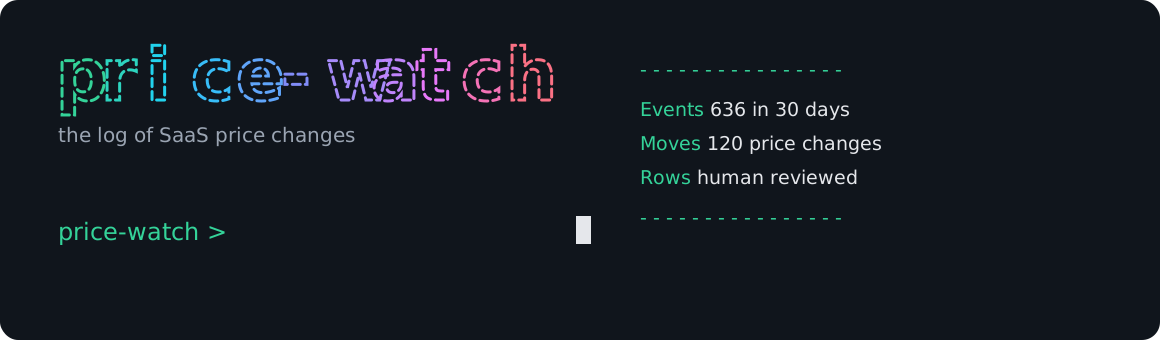
The log sits behind the pricing database, 494 tools deep. Dated rows, old and new values where a price moved, a human sign-off on each. The 30 days to July 10, 2026 carried 636 entries, 120 of them outright price moves.
What it watches
| Event | Meaning |
|---|---|
plan_price_change |
a plan's price moved; the row carries old and new values |
plan_added / plan_removed |
a tier appeared or disappeared |
plan_renamed |
same plan, new label |
billing_model_changed |
flat to usage, monthly to annual, that kind of switch |
pricing_change |
a wider correction, like a fee schedule refresh |
The week of July 6, verbatim from the feed. Bluehost raised Basic from $1.99 to $3.99. Screaming Frog cut its paid tier from $279 to $199. Namecheap dropped Stellar to $2.28. Chargebee re-read Starter as free where it used to say $250 a month. Binance refreshed its spot maker and taker schedule, and Coinbase touched both Advanced Trade fees and the Coinbase One tiers.
<details> <summary><b>What the raw rows behind that digest look like</b></summary>
  bluehost / Basic             cloud-hosting  2026-07-06
- $1.99
+ $3.99

  screaming-frog / Paid        seo-tools      2026-07-06
- $279
+ $199

  namecheap / Stellar          cloud-hosting  2026-07-06
- $4.66
+ $2.28

  chargebee / Starter          payments       2026-07-08
- $250/mo
+ free
Hosting swings hardest week to week; intro rates expire, renewal ladders kick in, and the log catches each step with a date.
</details>
Ask it
Did Notion change anything this quarter?
product_changes returns dated rows for one slug. Notion right now: quiet quarter, last verified July 4. The human-readable trail is its price history page.
What went up the most this month?
biggest_increases ranks the sharpest hikes in a window. Surfshark's intro-rate expiry tops the current one.
Is anything moving in cloud hosting?
category_changes sweeps one category. Hosting logged three moves in the first week of July alone.
What does Framer charge today, and is that new?
check_price returns the current verified price plus the last change touching it. recent_changes is the same idea for the whole catalog, newest first.
How a call flows
sequenceDiagram
    participant A as Assistant
    participant S as price-watch
    participant F as changelog feed
    A->>S: biggest_increases, last 30 days
    S->>F: fetch once, cache 6h
    F-->>S: 636 dated entries
    S-->>A: ranked hikes, old and new prices, dates
    Note over A: answer cites dates,<br/>not vibes
The feed itself is public, llms-changelog.json, and the server filters it locally. Five tools, three prompts on top: recent_price_moves for a window digest, track_product for one tool's status and direction, category_price_watch for a category sweep with its sharpest hikes.
Hook it up
{
  "mcpServers": {
    "price-watch": {
      "command": "npx",
      "args": ["-y", "@comparedge/price-watch-mcp@latest"]
    }
  }
}
Claude Desktop reads ~/Library/Application Support/Claude/claude_desktop_config.json, Cursor takes it under Settings then MCP, VS Code with Copilot uses .vscode/mcp.json. Restart the client and five tools show up. No key, no signup, zero dependencies. Client walkthroughs sit in the setup docs.
Why trust a log
Every row passed the same verification process before it landed; the feed carries each sign-off date. Month-by-month roundups of the same data become the pricing reports, and the raw rows ship as open pricing data under CC BY 4.0.
The server fetches two public feeds from comparedge.com, caches them for six hours, filters everything on your machine, and serves the last good copy if a refresh fails. The catalog sibling and the token-cost sibling live under the same MCP family roof.
MIT. JSON-RPC 2.0 over stdio.
Recommended Servers

playwright-mcp
A Model Context Protocol server that enables LLMs to interact with web pages through structured accessibility snapshots without requiring vision models or screenshots.

Magic Component Platform (MCP)
An AI-powered tool that generates modern UI components from natural language descriptions, integrating with popular IDEs to streamline UI development workflow.

Audiense Insights MCP Server
Enables interaction with Audiense Insights accounts via the Model Context Protocol, facilitating the extraction and analysis of marketing insights and audience data including demographics, behavior, and influencer engagement.

VeyraX MCP
Single MCP tool to connect all your favorite tools: Gmail, Calendar and 40 more.

graphlit-mcp-server
The Model Context Protocol (MCP) Server enables integration between MCP clients and the Graphlit service. Ingest anything from Slack to Gmail to podcast feeds, in addition to web crawling, into a Graphlit project - and then retrieve relevant contents from the MCP client.

Kagi MCP Server
An MCP server that integrates Kagi search capabilities with Claude AI, enabling Claude to perform real-time web searches when answering questions that require up-to-date information.

E2B
Using MCP to run code via e2b.

Neon Database
MCP server for interacting with Neon Management API and databases

Exa Search
A Model Context Protocol (MCP) server lets AI assistants like Claude use the Exa AI Search API for web searches. This setup allows AI models to get real-time web information in a safe and controlled way.

Qdrant Server
This repository is an example of how to create a MCP server for Qdrant, a vector search engine.