
Omega
Persistent memory for AI coding agents
README
OMEGA
The memory system for AI coding agents. Decisions, lessons, and context that persist across sessions.






mcp-name: io.github.omega-memory/omega-memory
The Problem
AI coding agents are stateless. Every new session starts from zero.
- Context loss. Agents forget every decision, preference, and architectural choice between sessions. Developers spend 10-30 minutes per session re-explaining context that was already established.
- Repeated mistakes. Without learning from past sessions, agents make the same errors over and over. They don't remember what worked, what failed, or why a particular approach was chosen.
OMEGA gives AI coding agents long-term memory and cross-session learning, all running locally on your machine.
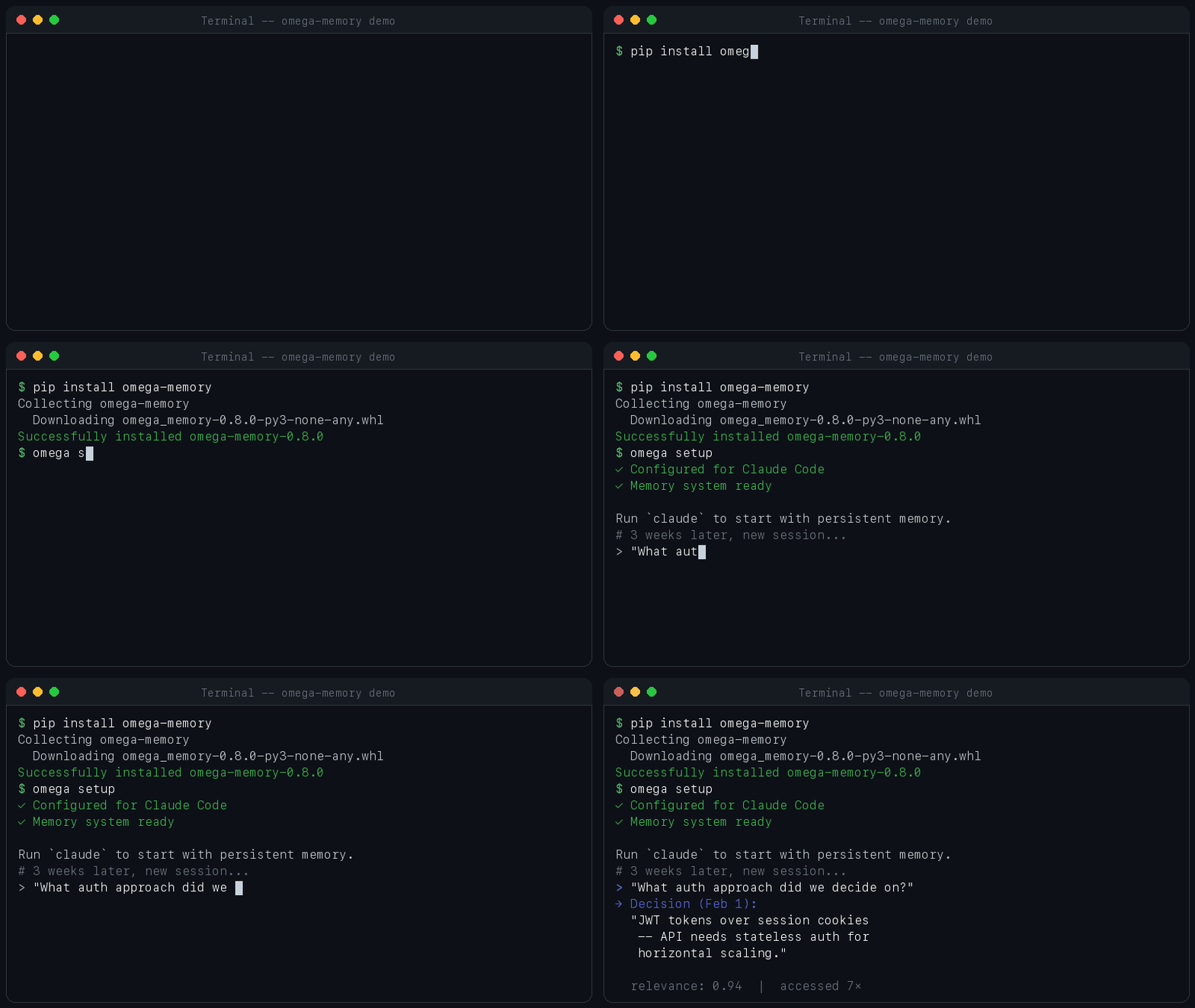
Quick Start
pip3 install omega-memory[server]   # install from PyPI (includes MCP server)
omega setup                         # auto-configures Claude Code + hooks
omega doctor                        # verify everything works
Important:
omega setupdownloads the embedding model and configures your editor. Don't skip it.
That's it. Start a new Claude Code session and say "Remember that we always use early returns and never nest more than 2 levels." Close the session. Open a new one and ask "What are my code style preferences?" OMEGA recalls it instantly.
Full architecture walkthrough and setup guide: omegamax.co/quickstart
<details> <summary><strong>Alternative install methods</strong></summary>
pipx install omega-memory[server]              # recommended for global install (no venv needed)
pip3 install omega-memory[server]              # standard (may need a venv)
python3 -m pip install omega-memory[server]    # if pip3 is not available
</details>
<details> <summary><strong>Library-only install (no MCP server)</strong></summary>
If you only need OMEGA as a Python library for scripts, CI/CD, or automation, you can skip the MCP server entirely:
pip3 install omega-memory # core only, no MCP server process
from omega import store, query, remember

store("Always use TypeScript strict mode", "user_preference")
results = query("TypeScript preferences")
This gives you the full storage and retrieval API without running an MCP server (~50 MB lighter, no background process). You won't get MCP tools in your editor, but hooks still work:
omega setup --hooks-only # auto-capture + memory surfacing, no MCP server (~600MB RAM saved)
</details>
Using Cursor, Windsurf, or Zed? Install with pip3 install omega-memory[server], then:
omega setup --client cursor          # writes ~/.cursor/mcp.json
omega setup --client windsurf        # writes ~/.codeium/windsurf/mcp_config.json
omega setup --client zed             # writes ~/.config/zed/settings.json
What Happens Next
After omega setup, OMEGA works in the background. No commands to learn.
Auto-capture — When you make a decision or debug an issue, OMEGA detects it and stores it automatically.
Auto-surface — When you edit a file or start a session, OMEGA surfaces relevant memories from past sessions — even ones you forgot about.
Checkpoint & resume — Stop mid-task, pick up in a new session exactly where you left off.
You can also explicitly tell Claude to remember things:
"Remember that we use JWT tokens, not session cookies"
But the real value is what OMEGA does without being asked.
Examples
Architectural Decisions
"Remember: we chose PostgreSQL over MongoDB for the orders service because we need ACID transactions for payment processing."
Three weeks later, in a new session:
"I'm adding a caching layer to the orders service — what should I know?"
OMEGA surfaces the PostgreSQL decision automatically, so Claude doesn't suggest a MongoDB-style approach.
Learning from Mistakes
You spend 30 minutes debugging a Docker build failure. Claude figures it out:
"The node_modules volume mount was shadowing the container's node_modules. Fixed by adding an anonymous volume."
OMEGA auto-captures this as a lesson. Next time anyone hits the same Docker issue, Claude already knows the fix.
Code Preferences
"Remember: always use early returns. Never nest conditionals more than 2 levels deep. Prefer
constoverlet."
Every future session follows these rules without being told again.
Task Continuity
You're mid-refactor when you need to stop:
"Checkpoint this — I'm halfway through migrating the auth middleware to the new pattern."
Next session:
"Resume the auth middleware task."
Claude picks up exactly where you left off — files changed, decisions made, what's left to do.
Error Patterns
Claude encounters the same ECONNRESET three sessions in a row. Each time OMEGA surfaces the previous fix:
[error_pattern] ECONNRESET on API calls — caused by connection pool exhaustion.
Fix: set maxSockets to 50 in the http agent config.
Accessed 3 times
No more re-debugging the same issue.
Key Features
-
Auto-Capture & Surfacing — Hook system automatically captures decisions and lessons, and surfaces relevant memories before edits, at session start, and during work.
-
Persistent Memory — Stores decisions, lessons, error patterns, and preferences with semantic search. Your agent recalls what matters without you re-explaining everything each session.
-
Semantic Search — bge-small-en-v1.5 embeddings + sqlite-vec for fast, accurate retrieval. Finds relevant memories even when the wording is different.
-
Cross-Session Learning — Lessons, preferences, and error patterns accumulate over time. Agents learn from past mistakes and build on previous decisions.
-
Forgetting Intelligence — Memories decay naturally over time, conflicts auto-resolve, and every deletion is audited. Preferences and error patterns are exempt from decay.
-
Graph Relationships — Memories are linked with typed edges (related, supersedes, contradicts). Traverse the knowledge graph to find connected context.
-
Encryption at Rest (optional) — AES-256-GCM encrypted storage with macOS Keychain integration.
pip install omega-memory[encrypt] -
Plugin Architecture — Extensible via entry points. Add custom tools and handlers through the plugin system.
How OMEGA Compares
| Feature | OMEGA | MEMORY.md | Mem0 | Basic MCP Memory |
|---|---|---|---|---|
| Persistent across sessions | Yes | Yes | Yes | Yes |
| Semantic search | Yes | No (file grep only) | Yes | Varies |
| Auto-capture (no manual effort) | Yes | No (manual edits) | Yes (cloud) | No |
| Contradiction detection | Yes | No | No | No |
| Checkpoint & resume tasks | Yes | No | No | No |
| Graph relationships | Yes | No | No | No |
| Cross-session learning | Yes | Limited | Yes | No |
| Intelligent forgetting | Yes | No (grows forever) | No | No |
| Local-only (no cloud/API keys) | Yes | Yes | No (API key required) | Yes |
| Setup complexity | pip3 install + omega setup |
Zero (built-in) | API key + cloud config | Manual JSON config |
MEMORY.md is Claude Code's built-in markdown file -- great for simple notes, but no search, no auto-capture, and it grows unbounded. Mem0 offers strong semantic memory but requires cloud API keys and has no checkpoint/resume or contradiction detection. Basic MCP memory servers (e.g., simple key-value stores) provide persistence but lack the intelligence layer -- no semantic search, no forgetting, no graph.
OMEGA gives you the best of all worlds: fully local, zero cloud dependencies, with intelligent features that go far beyond simple storage.
Full comparison with methodology at omegamax.co/compare.
Benchmark
OMEGA scores 95.4% task-averaged on LongMemEval (ICLR 2025), an academic benchmark that tests long-term memory across 5 categories: information extraction, multi-session reasoning, temporal reasoning, knowledge updates, and preference tracking. Raw accuracy is 466/500 (93.2%). Task-averaged scoring (mean of per-category accuracies) is the standard methodology used by other systems on the leaderboard. This is the #1 score on the leaderboard.
| System | Score | Notes |
|---|---|---|
| OMEGA | 95.4% | #1 |
| Mastra | 94.87% | #2 |
| Emergence | 86.0% | — |
| Zep/Graphiti | 71.2% | Published in their paper |
Details and methodology at omegamax.co/benchmarks.
Compatibility
| Client | 12 MCP Tools | Auto-Capture Hooks | Setup Command |
|---|---|---|---|
| Claude Code | Yes | Yes | omega setup |
| Cursor | Yes | No | omega setup --client cursor |
| Windsurf | Yes | No | omega setup --client windsurf |
| Zed | Yes | No | omega setup --client zed |
| Any MCP Client | Yes | No | Manual config (see docs) |
All clients get full access to all 12 core memory tools. Auto-capture hooks (automatic memory surfacing and context capture) require Claude Code.
Requires Python 3.11+. macOS and Linux supported. Windows via WSL.
Remote / SSH Setup
Claude Code's SSH support lets you run your agent on a remote server from any device. OMEGA makes that server remember everything across sessions and reconnections.
# On your remote server (any Linux VPS — no GPU needed)
pip3 install omega-memory[server]
omega setup
omega doctor
That's it. Every SSH session — from your laptop, phone, or tablet — now has full memory of every previous session on that server.
Why this matters:
- Device-agnostic memory — SSH in from any device, OMEGA's memory graph is on the server waiting for you
- Survives disconnects — SSH drops? Reconnect and
omega_resume_taskpicks up exactly where you left off - Always-on accumulation — A cloud VM running 24/7 means your memory graph grows continuously
- Team-ready — Multiple developers SSH to the same server? OMEGA tracks who's working on what with file claims, handoff notes, and peer messaging
Requirements: Any VPS with Python 3.11+ (~337 MB RAM after first query). SQLite + CPU-only ONNX embeddings — zero external services.
<details> <summary><strong>Architecture & Advanced Details</strong></summary>
Architecture
               ┌─────────────────────┐
               │    Claude Code       │
               │  (or any MCP host)   │
               └──────────┬──────────┘
                          │ stdio/MCP
               ┌──────────▼──────────┐
               │   OMEGA MCP Server   │
               │   12 memory tools    │
               └──────────┬──────────┘
                          │
               ┌──────────▼──────────┐
               │    omega.db (SQLite) │
               │ memories | edges |   │
               │     embeddings       │
               └──────────────────────┘
Single database, modular handlers. Additional tools available via the plugin system.
MCP Tools Reference
12 core memory tools are available as an MCP server. Full tool reference at omegamax.co/docs.
| Tool | What it does |
|---|---|
omega_store |
Store typed memory (decision, lesson, error, preference, summary) |
omega_query |
Semantic or phrase search with tag filters and contextual re-ranking |
omega_lessons |
Cross-session lessons ranked by access count |
omega_welcome |
Session briefing with recent memories and profile |
omega_profile |
Read or update the user profile |
omega_checkpoint |
Save task state for cross-session continuity |
omega_resume_task |
Resume a previously checkpointed task |
omega_similar |
Find memories similar to a given one |
omega_traverse |
Walk the relationship graph |
omega_compact |
Cluster and summarize related memories |
omega_consolidate |
Prune stale memories, cap summaries, clean edges |
omega_timeline |
Memories grouped by day |
omega_remind |
Set time-based reminders |
omega_feedback |
Rate surfaced memories (helpful, unhelpful, outdated) |
Additional utility tools for health checks, backup/restore, stats, editing, and deletion are also available. See omegamax.co/docs for the full reference.
CLI
| Command | Description |
|---|---|
omega setup |
Create dirs, download model, register MCP, install hooks (--hooks-only to skip MCP) |
omega doctor |
Verify installation health |
omega status |
Memory count, store size, model status |
omega query <text> |
Search memories by semantic similarity |
omega store <text> |
Store a memory with a specified type |
omega timeline |
Show memory timeline grouped by day |
omega activity |
Show recent session activity overview |
omega stats |
Memory type distribution and health summary |
omega consolidate |
Deduplicate, prune, and optimize memory |
omega compact |
Cluster and summarize related memories |
omega backup |
Back up omega.db (keeps last 5) |
omega validate |
Validate database integrity |
omega logs |
Show recent hook errors |
omega migrate-db |
Migrate legacy JSON to SQLite |
Hooks
All hooks dispatch via fast_hook.py → daemon UDS socket, with fail-open semantics.
| Hook | Handlers | Purpose |
|---|---|---|
| SessionStart | session_start |
Welcome briefing with recent memories |
| Stop | session_stop |
Session summary |
| UserPromptSubmit | auto_capture |
Auto-capture lessons/decisions |
| PostToolUse | surface_memories |
Surface relevant memories during work |
Storage
| Path | Purpose |
|---|---|
~/.omega/omega.db |
SQLite database (memories, embeddings, edges) |
~/.omega/profile.json |
User profile |
~/.omega/hooks.log |
Hook error log |
~/.cache/omega/models/bge-small-en-v1.5-onnx/ |
ONNX embedding model |
Search Pipeline
- Vector similarity via sqlite-vec (cosine distance, 384-dim bge-small-en-v1.5)
- Full-text search via FTS5 (fast keyword matching)
- Type-weighted scoring (decisions/lessons weighted 2x)
- Contextual re-ranking (boosts by tag, project, and content match)
- Deduplication at query time
- Time-decay weighting (old unaccessed memories rank lower)
Memory Lifecycle
- Dedup: SHA256 hash (exact) + embedding similarity 0.85+ (semantic) + Jaccard per-type
- Evolution: Similar content (55-95%) appends new insights to existing memories
- TTL: Session summaries expire after 1 day, lessons/preferences are permanent
- Auto-relate: Creates
relatededges (similarity >= 0.45) to top-3 similar memories - Compaction: Clusters and summarizes related memories
- Decay: Unaccessed memories lose ranking weight over time (floor 0.35); preferences and errors exempt
- Conflict detection: Contradicting memories auto-detected on store; decisions auto-resolve, lessons flagged
Memory Footprint
- Startup: ~31 MB RSS
- After first query (ONNX model loaded): ~337 MB RSS
- Database: ~10.5 MB for ~242 memories
Install from Source
git clone https://github.com/omega-memory/omega-memory.git
cd omega-memory
pip3 install -e ".[server,dev]"
omega setup
omega setup will:
- Create
~/.omega/directory - Download the ONNX embedding model (~90 MB) to
~/.cache/omega/models/ - Register
omega-memoryas an MCP server in~/.claude.json - Install session hooks in
~/.claude/settings.json - Add a managed
<!-- OMEGA:BEGIN -->block to~/.claude/CLAUDE.md
All changes are idempotent — running omega setup again won't duplicate entries.
</details>
Troubleshooting
omega doctor shows FAIL on import:
- Ensure
pip3 install -e ".[server]"from the repo root - Check
python3 -c "import omega"works
MCP server fails to start:
- Run
pip3 install omega-memory[server](the[server]extra includes the MCP package)
MCP server not registered:
claude mcp add omega-memory -- python3 -m omega.server.mcp_server
Hooks not firing:
- Check
~/.claude/settings.jsonhas OMEGA hook entries - Check
~/.omega/hooks.logfor errors
Development
pip3 install -e ".[server,dev]"
pytest tests/
ruff check src/              # Lint
Uninstall
claude mcp remove omega-memory
rm -rf ~/.omega ~/.cache/omega
pip3 uninstall omega-memory
Manually remove OMEGA entries from ~/.claude/settings.json and the <!-- OMEGA:BEGIN --> block from ~/.claude/CLAUDE.md.
Star History
Contributing
License
Apache-2.0 — see LICENSE for details.
Recommended Servers

playwright-mcp
A Model Context Protocol server that enables LLMs to interact with web pages through structured accessibility snapshots without requiring vision models or screenshots.

Magic Component Platform (MCP)
An AI-powered tool that generates modern UI components from natural language descriptions, integrating with popular IDEs to streamline UI development workflow.

Audiense Insights MCP Server
Enables interaction with Audiense Insights accounts via the Model Context Protocol, facilitating the extraction and analysis of marketing insights and audience data including demographics, behavior, and influencer engagement.

VeyraX MCP
Single MCP tool to connect all your favorite tools: Gmail, Calendar and 40 more.

graphlit-mcp-server
The Model Context Protocol (MCP) Server enables integration between MCP clients and the Graphlit service. Ingest anything from Slack to Gmail to podcast feeds, in addition to web crawling, into a Graphlit project - and then retrieve relevant contents from the MCP client.

Kagi MCP Server
An MCP server that integrates Kagi search capabilities with Claude AI, enabling Claude to perform real-time web searches when answering questions that require up-to-date information.

E2B
Using MCP to run code via e2b.

Neon Database
MCP server for interacting with Neon Management API and databases

Exa Search
A Model Context Protocol (MCP) server lets AI assistants like Claude use the Exa AI Search API for web searches. This setup allows AI models to get real-time web information in a safe and controlled way.

Qdrant Server
This repository is an example of how to create a MCP server for Qdrant, a vector search engine.