
mcp-server-master
This repository provides a template for creating MCP servers with Python, including installation instructions and tools for testing with the MCP Inspector.
README
Installation Guide
<!-- Minor update: Documentation improved on June 6, 2025 -->
Adding MCP to your python project
Installation with uv (recommended)
We recommend using uv to manage your Python projects.
Installing from pyproject.toml RECOMENDED
If you prefer to manage your dependencies using pyproject.toml, you can add all libraries to your project:
uv sync
Installing manually
If you haven't created a uv-managed project yet, create one:
uv init mcp-server-demo
cd mcp-server-demo
Then add MCP to your project dependencies:
uv add "mcp[cli]"
Alternatively, for projects using pip for dependencies:
pip install "mcp[cli]"
Testing the installation
- Make sure you activate your virtual environment if you're using one.
- Run de
client.pyfile provided
python client.py
Running the standalone MCP development tools
To run the mcp command with uv:
uv run mcp
MCP Inspector
The MCP inspector is a developer tool for testing and debugging MCP servers.
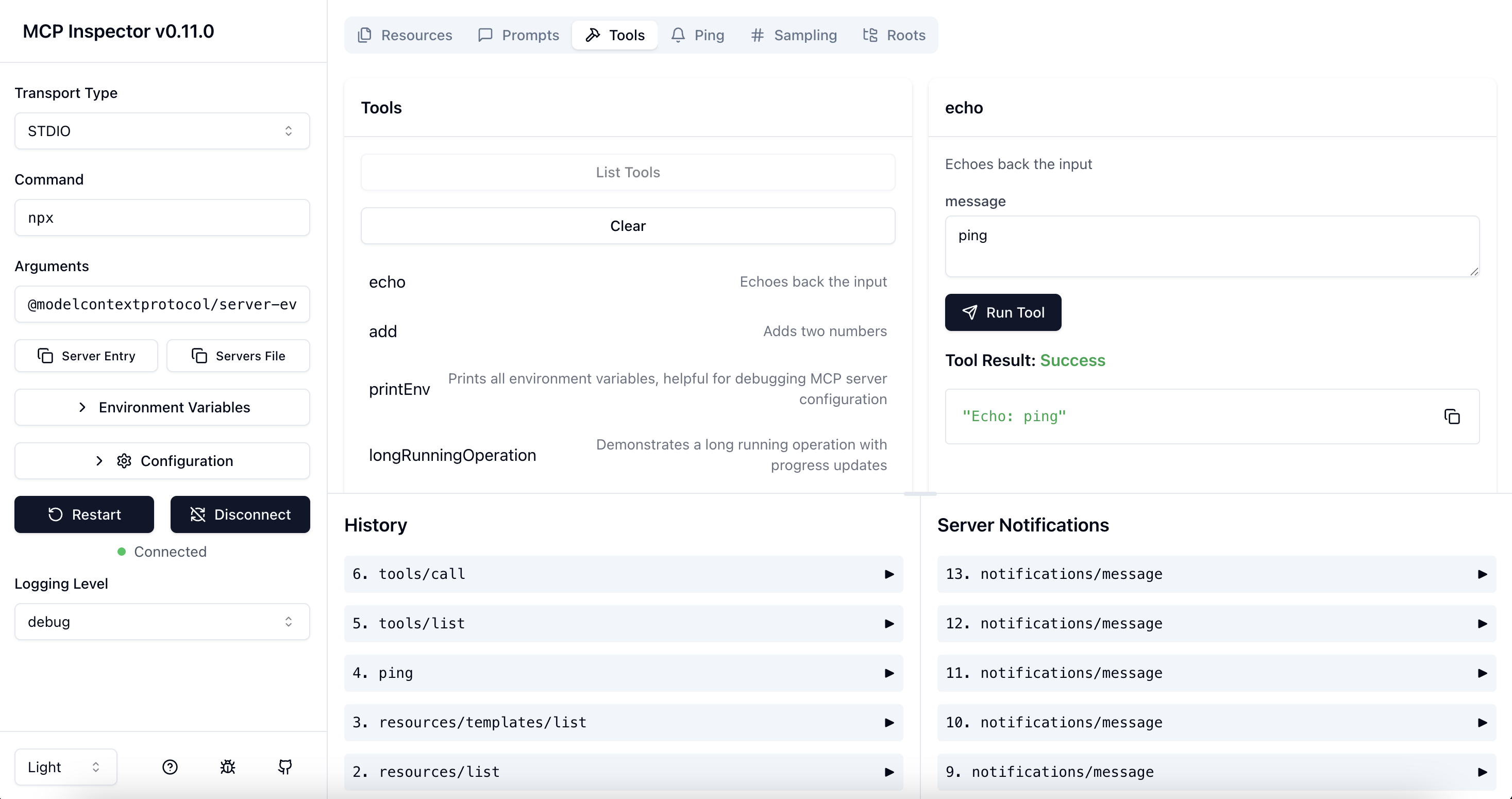
Architecture Overview
The MCP Inspector consists of two main components that work together:
- MCP Inspector Client (MCPI): A React-based web UI that provides an interactive interface for testing and debugging MCP servers
- MCP Proxy (MCPP): A Node.js server that acts as a protocol bridge, connecting the web UI to MCP servers via various transport methods (stdio, SSE, streamable-http)
Note that the proxy is not a network proxy for intercepting traffic. Instead, it functions as both an MCP client (connecting to your MCP server) and an HTTP server (serving the web UI), enabling browser-based interaction with MCP servers that use different transport protocols.
Running the Inspector
Requirements
- Node.js: ^22.7.5
Quick Start (UI mode)
To get up and running right away with the UI, just execute the following:
npx @modelcontextprotocol/inspector
The server will start up and the UI will be accessible at http://localhost:6274.
From an MCP server repository
To inspect an MCP server implementation, there's no need to clone this repo. Instead, use npx. For example, if your server is built at build/index.js:
npx @modelcontextprotocol/inspector node build/index.js
For python server with uv:
npx @modelcontextprotocol/inspector uv run main.py
Recommended Servers

playwright-mcp
A Model Context Protocol server that enables LLMs to interact with web pages through structured accessibility snapshots without requiring vision models or screenshots.

Magic Component Platform (MCP)
An AI-powered tool that generates modern UI components from natural language descriptions, integrating with popular IDEs to streamline UI development workflow.

Audiense Insights MCP Server
Enables interaction with Audiense Insights accounts via the Model Context Protocol, facilitating the extraction and analysis of marketing insights and audience data including demographics, behavior, and influencer engagement.

VeyraX MCP
Single MCP tool to connect all your favorite tools: Gmail, Calendar and 40 more.

graphlit-mcp-server
The Model Context Protocol (MCP) Server enables integration between MCP clients and the Graphlit service. Ingest anything from Slack to Gmail to podcast feeds, in addition to web crawling, into a Graphlit project - and then retrieve relevant contents from the MCP client.

Kagi MCP Server
An MCP server that integrates Kagi search capabilities with Claude AI, enabling Claude to perform real-time web searches when answering questions that require up-to-date information.

E2B
Using MCP to run code via e2b.

Neon Database
MCP server for interacting with Neon Management API and databases

Qdrant Server
This repository is an example of how to create a MCP server for Qdrant, a vector search engine.

Exa Search
A Model Context Protocol (MCP) server lets AI assistants like Claude use the Exa AI Search API for web searches. This setup allows AI models to get real-time web information in a safe and controlled way.