
mcp-memory-gateway
An MCP server that provides memory management and gateway capabilities, enabling persistent storage and retrieval of contextual information across sessions.
README
MCP Memory Gateway






Pre-action gates that physically block AI coding agents from repeating known mistakes. Captures feedback, auto-promotes failures into prevention rules, and enforces them via PreToolUse hooks. Works with Claude Code, Codex, Gemini, Amp, Cursor.
Honest disclaimer: This is a context injection system, not RLHF. LLM weights are not updated by thumbs-up/down signals. What actually happens: feedback is validated, promoted to searchable memory, and recalled at session start so agents have project history they'd otherwise lose. That's genuinely valuable — but it's context engineering, not reinforcement learning.
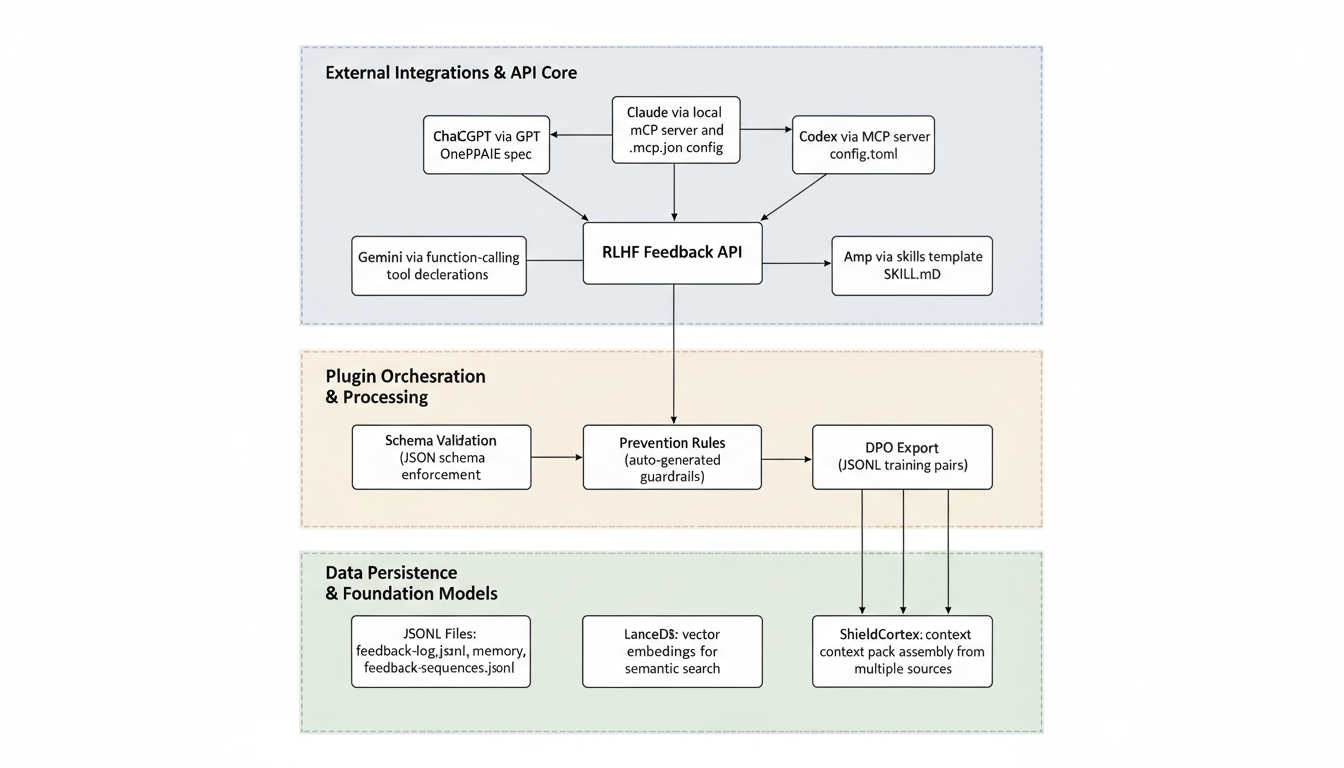
Works with any MCP-compatible agent: Claude, Codex, Gemini, Amp, Cursor, OpenCode.
Verification evidence for shipped features lives in docs/VERIFICATION_EVIDENCE.md.
Repo-local operator guides:
MCP Memory Gateway keeps one sharp agent on task. Continuity tools help you resume work. The resumed session stays sharper with recall, reliability rules, pre-action gates, and verification layered on top of that continuity workflow without another planner or swarm.
Claude Workflow Hardening
If you are selling or deploying Claude-first delivery, the cleanest commercial wedge is not "AI employee" hype. It is a Workflow Hardening Sprint for one workflow with enough memory, gates, and proof to ship safely.
Use that motion when a buyer already has:
- one workflow owner
- one repeated failure pattern or rollout blocker
- one buyer who needs proof before broader rollout
That maps cleanly to three offers:
- Workflow Hardening Sprint for one production workflow with business value
- code modernization guardrails for long-running migration and refactor sessions
- hosted Pro at
$49 one-timewhen the team only needs synced memory, gates, and usage analytics
Use these assets in sales and partner conversations:
Claude Desktop Extensions
This repo already ships a Claude Desktop extension lane:
- Claude metadata:
.claude-plugin/plugin.json - Claude marketplace metadata:
.claude-plugin/marketplace.json - Claude extension install and support guide:
.claude-plugin/README.md - Claude Desktop bundle builder:
npm run build:claude-mcpb - Claude Desktop bundle launcher:
.claude-plugin/bundle/server/index.js - Claude Desktop bundle icon:
.claude-plugin/bundle/icon.png - Internal submission packet: docs/CLAUDE_DESKTOP_EXTENSION.md
Install locally today with:
claude mcp add rlhf -- npx -y mcp-memory-gateway serve
Build a submission-ready .mcpb locally with:
npm run build:claude-mcpb
Treat Anthropic directory inclusion as a discoverability and trust lane, not as revenue proof or partner proof.
Cursor Marketplace
This repo now ships a submission-ready Cursor plugin bundle:
- Root marketplace manifest:
.cursor-plugin/marketplace.json - Plugin directory:
plugins/cursor-marketplace/ - Plugin MCP config:
plugins/cursor-marketplace/.mcp.json
Use MCP Memory Gateway as the display name in Cursor Marketplace and Cursor Directory forms. Keep mcp-memory-gateway as the plugin slug and npm package name.
That package keeps the Cursor review surface intentionally small: one MCP server bundle that leads with Pre-Action Gates and keeps runtime enforcement close to the agent loop. The runtime launcher now targets mcp-memory-gateway@latest, so npm releases can flow into the plugin runtime without editing the config. Marketplace metadata, screenshots, and directory copy still require an explicit plugin refresh. Until the public listing is approved, Cursor users can still install locally with npx mcp-memory-gateway init.
Operational guidance for Cursor releases and promotion lives in docs/CURSOR_PLUGIN_OPERATIONS.md.
Visual Demo: Experience the Magic
Stop imagining and see the MCP Memory Gateway in action. This is the difference between an agent that repeats mistakes and one that actually improves.
1. The "Repeat Mistake" Cycle (Without Gateway)
Agent: I'll fix the bug and push directly to main.
User: No, you forgot to check the PR review thread again!
Agent: Sorry, I'll remember next time. (It won't).
2. The "Agentic Memory" Cycle (With Gateway)
Watch how the Pre-Action Gates and Reasoning Traces physically block the failure:
User: Fix the bug and push.
Agent: I'll apply the fix... [Applying Edit]
Agent: Now I'll push to main... [Executing: git push]

🛑 GATE BLOCKED: push-without-thread-check
──────────────────────────────────────────────────
Reason    : Rule promoted from 3+ previous failures.
Condition : No 'gh pr view' or thread check detected in current session.
Action    : Blocked. Please check review threads first.
──────────────────────────────────────────────────

Agent: My apologies. I see that I am blocked because I haven't checked
the PR threads. I'll do that now... [Executing: gh pr view]

Success! Agent finds a blocker in the thread, fixes it, and then pushes.
3. Deep Troubleshooting with Reasoning Traces
Every captured signal now includes a Reasoning Trace, making "black-box" failures transparent:
# Capture feedback with the new --reasoning flag
npx mcp-memory-gateway capture --feedback=down \
  --context="Agent skipped unit tests" \
  --reasoning="The agent assumed the change was too small to break anything, but it regressed the auth flow." \
  --tags="testing,regression"
Now, when the agent starts its next session, it doesn't just see "Don't skip tests." It sees the logic that led to the failure, preventing the same cognitive trap.
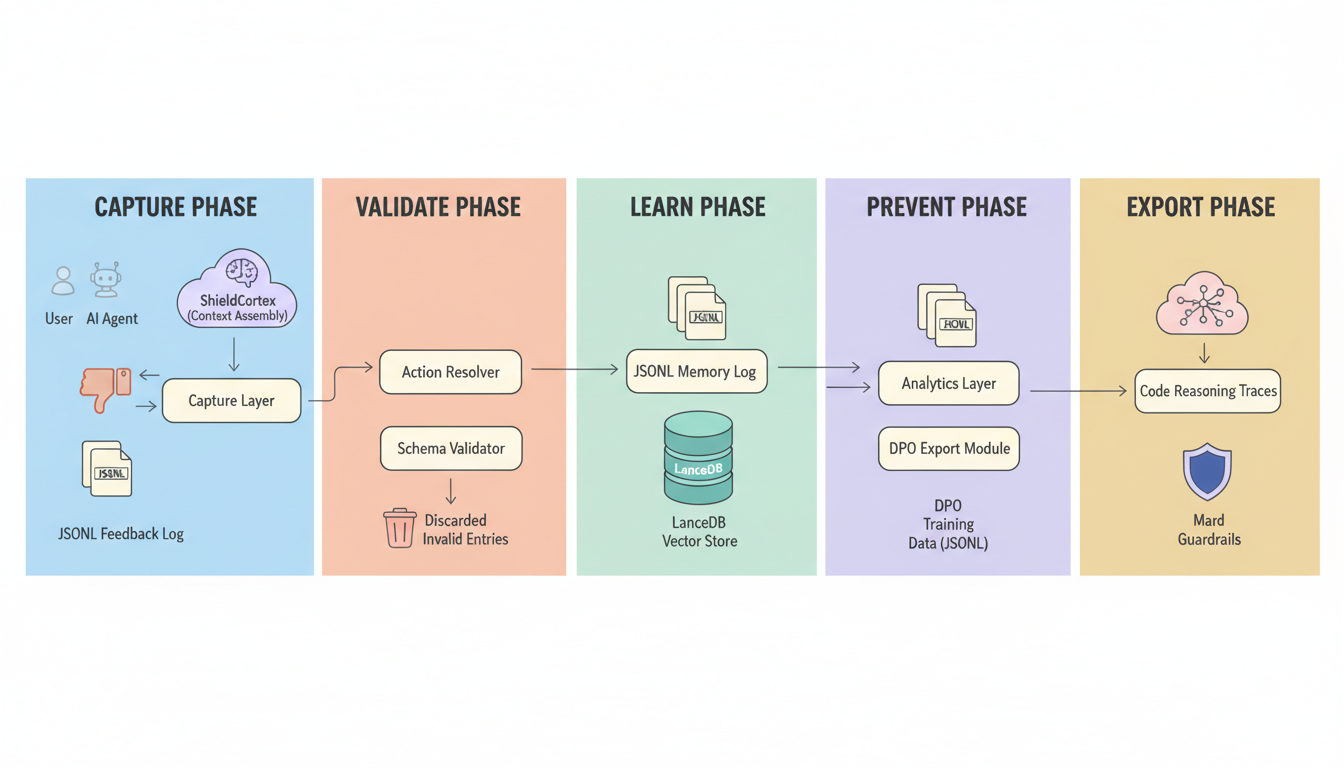
- Capture —
capture_feedbackMCP tool accepts signals with structured context (vague "thumbs down" is rejected) - Validate — Rubric engine gates promotion — requires specific failure descriptions, not vibes
- Remember — Promoted memories stored in JSONL + LanceDB vectors for semantic search
- Prevent — Repeated failures auto-generate prevention rules (the actual value — agents follow these when loaded)
- Gate — Pre-action blocking via PreToolUse hooks — physically prevents known mistakes before they happen
- Recall —
recalltool injects relevant past context into current session (this is the mechanism that works) - Export — DPO/KTO pairs for optional downstream fine-tuning (separate from runtime behavior)
- Bridge — JSONL file watcher auto-ingests signals from external sources (Amp plugins, hooks, scripts)
What Works vs. What Doesn't
| ✅ Actually works | ❌ Does not work |
|---|---|
recall injects past context — agent reads and uses it |
Thumbs up/down changing agent behavior mid-session |
remember persists decisions across sessions |
LLM weight updates from feedback signals |
| Prevention rules — followed when loaded at session start | Feedback stats improving agent performance automatically |
| Pre-action gates — physically block known mistakes | "Learning curve" implying the agent itself learns |
| Auto-promotion — 3+ failures become blocking rules | Agents self-correcting without context injection |
Quick Start
# Recommended: essential profile (5 high-ROI tools)
claude mcp add rlhf -- npx -y mcp-memory-gateway serve
codex mcp add rlhf -- npx -y mcp-memory-gateway serve
amp mcp add rlhf -- npx -y mcp-memory-gateway serve
gemini mcp add rlhf "npx -y mcp-memory-gateway serve"

# Or auto-detect all installed platforms
npx mcp-memory-gateway init

# Auto-wire PreToolUse hooks (blocks known mistakes before they happen)
npx mcp-memory-gateway init --agent claude-code
npx mcp-memory-gateway init --agent codex
npx mcp-memory-gateway init --agent gemini

# Audit readiness before a long-running workflow
npx mcp-memory-gateway doctor
Profiles: Set
RLHF_MCP_PROFILE=essentialfor the lean 5-tool setup (recommended), or leave unset for the full 12-tool pipeline. See MCP Tools for details.
Pair It With Continuity Tools
Project continuity and agent reliability are complementary, not interchangeable.
- Use your editor, assistant, or resume workflow to regain context quickly.
- Use MCP Memory Gateway as the reliability layer for recall, gates, and proof.
If an external tool can append structured JSONL entries with a source field, the built-in watcher can ingest them through the normal feedback pipeline:
{"source":"editor-brief","signal":"down","context":"Agent resumed without reading the migration notes","whatWentWrong":"Skipped the resume brief and edited the wrong table","whatToChange":"Read the project brief before schema changes","tags":["continuity","resume","database"]}
npx mcp-memory-gateway watch --source editor-brief
That routes the event through validation, memory promotion, vector indexing, and export eligibility without adding a second integration stack.
Guide: docs/guides/continuity-tools-integration.md
Pre-Action Gates
Gates are the enforcement layer. They physically block tool calls that match known failure patterns — no agent cooperation required.
Agent tries git push → PreToolUse hook fires → gates-engine checks rules → BLOCKED (no PR thread check)
How it works
init --agent claude-codeauto-wires a PreToolUse hook into your agent settings- The hook pipes every Bash command through
gates-engine.js - Gates match tool calls against regex patterns and block/warn
- Auto-promotion: 3+ same-tag failures → auto-creates a
warngate. 5+ → upgrades toblock.
Built-in gates
| Gate | Action | What it blocks |
|---|---|---|
push-without-thread-check |
block | git push without checking PR review threads first |
package-lock-reset |
block | git checkout <branch> -- package-lock.json |
force-push |
block | git push --force / -f |
protected-branch-push |
block | Direct push to develop/main/master |
env-file-edit |
warn | Editing .env files |
Custom gates
Define your own in config/gates/custom.json:
{
  "version": 1,
  "gates": [
    {
      "id": "no-npm-audit-fix",
      "pattern": "npm audit fix --force",
      "action": "block",
      "message": "npm audit fix --force can break dependencies. Review manually."
    }
  ]
}
Gate satisfaction
Some gates have unless conditions. To satisfy a gate before pushing:
# Via MCP tool
satisfy_gate(gateId: "push-without-thread-check", evidence: "0/42 unresolved")

# Via CLI
node scripts/gate-satisfy.js --gate push-without-thread-check --evidence "0 unresolved"
Evidence expires after 5 minutes (configurable TTL).
Dashboard
npx mcp-memory-gateway dashboard
📊 RLHF Dashboard
══════════════════════════════════════════════
  Approval Rate    : 26% → 45% (7-day trend ↑)
  Total Signals    : 190 (15 positive, 43 negative)

🛡️ Gate Enforcement
  Active Gates     : 7 (4 manual, 3 auto-promoted)
  Actions Blocked  : 12 this week
  Actions Warned   : 8 this week
  Top Blocked      : push-without-thread-check (5×)

⚡ Prevention Impact
  Estimated Saves  : 3.2 hours
  Rules Active     : 5 prevention rules
  Last Promotion   : pr-review (2 days ago)
MCP Tools
Essential (high-ROI — start here)
These 5 tools deliver ~80% of the value. Use the essential profile for a lean setup:
RLHF_MCP_PROFILE=essential claude mcp add rlhf -- npx -y mcp-memory-gateway serve
| Tool | Description |
|---|---|
capture_feedback |
Accept up/down signal + context, validate, promote to memory |
recall |
Vector-search past feedback and prevention rules for current task |
prevention_rules |
Generate prevention rules from repeated mistakes |
feedback_stats |
Approval rate, per-skill/tag breakdown, trend analysis |
feedback_summary |
Human-readable recent feedback summary |
Full pipeline (advanced)
These tools support fine-tuning workflows, context engineering, and audit trails. Use the default profile to enable all tools:
| Tool | Description | When you need it |
|---|---|---|
export_dpo_pairs |
Build DPO preference pairs from promoted memories | Fine-tuning a model on your feedback |
export_databricks_bundle |
Export RLHF logs and proof artifacts as a Databricks-ready analytics bundle | Warehousing local feedback, attribution, and proof data for Databricks / Genie Code analysis |
construct_context_pack |
Bounded context pack from contextfs | Custom retrieval for large projects |
evaluate_context_pack |
Record context pack outcome (closes learning loop) | Measuring retrieval quality |
list_intents |
Available action plan templates | Policy-gated workflows |
plan_intent |
Generate execution plan with policy checkpoints | Policy-gated workflows |
context_provenance |
Audit trail of context decisions | Debugging retrieval decisions |
satisfy_gate |
Record evidence that a gate condition is met | Unblocking gated actions (e.g., PR thread check) |
gate_stats |
Gate enforcement statistics (blocked/warned counts) | Monitoring gate effectiveness |
dashboard |
Full RLHF dashboard (approval rate, gates, prevention) | Overview of system health |
diagnose_failure |
Compile workflow, gate, approval, and MCP-tool constraints into a root-cause report | Systematic debugging for failed or suspect agent runs |
CLI
npx mcp-memory-gateway init              # Scaffold .rlhf/ + configure MCP
npx mcp-memory-gateway init --agent X    # + auto-wire PreToolUse hooks (claude-code/codex/gemini)
npx mcp-memory-gateway init --wire-hooks # Wire hooks only (auto-detect agent)
npx mcp-memory-gateway serve             # Start MCP server (stdio) + watcher
npx mcp-memory-gateway doctor            # Audit runtime isolation, bootstrap context, and MCP permission tier
npx mcp-memory-gateway dashboard         # Full RLHF dashboard with gate stats
npx mcp-memory-gateway north-star        # North Star progress: proof-backed workflow runs
npx mcp-memory-gateway gate-stats        # Gate enforcement statistics
npx mcp-memory-gateway status            # Learning curve dashboard
npx mcp-memory-gateway watch             # Watch .rlhf/ for external signals
npx mcp-memory-gateway capture           # Capture feedback via CLI
npx mcp-memory-gateway stats             # Analytics + Revenue-at-Risk
npx mcp-memory-gateway rules             # Generate prevention rules
npx mcp-memory-gateway export-dpo        # Export DPO training pairs
npx mcp-memory-gateway export-databricks # Export Databricks-ready analytics bundle
npx mcp-memory-gateway risk              # Train/query boosted risk scorer
npx mcp-memory-gateway self-heal         # Run self-healing diagnostics
Hosted growth tracking
The landing page ships first-party telemetry plus optional GA4 and Google Search Console hooks.
export RLHF_PUBLIC_APP_ORIGIN='https://rlhf-feedback-loop-production.up.railway.app'
export RLHF_BILLING_API_BASE_URL='https://rlhf-feedback-loop-production.up.railway.app'
export RLHF_FEEDBACK_DIR='/data/feedback'
export RLHF_GA_MEASUREMENT_ID='G-XXXXXXXXXX'          # optional
export RLHF_GOOGLE_SITE_VERIFICATION='token-value'    # optional
- Plausible stays on by default for lightweight page analytics.
- GA4 is only injected when
RLHF_GA_MEASUREMENT_IDis set. - Search Console verification meta is only injected when
RLHF_GOOGLE_SITE_VERIFICATIONis set. - Hosted deployments should set
RLHF_FEEDBACK_DIR=/data/feedback(or another durable path) so telemetry, billing ledgers, and proof-backed workflow-run evidence survive restarts. npx mcp-memory-gateway dashboardnow shows whether traffic, SEO, funnel, and revenue instrumentation are actually configured and receiving events.
JSONL File Watcher
The serve command automatically starts a background watcher that monitors feedback-log.jsonl for entries written by external sources (Amp plugins, shell hooks, CI scripts). These entries are routed through the full captureFeedback() pipeline — validation, memory promotion, vector indexing, and DPO eligibility.
# Standalone watcher
npx mcp-memory-gateway watch --source amp-plugin-bridge

# Process pending entries once and exit
npx mcp-memory-gateway watch --once
External sources write entries with a source field:
{"signal":"positive","context":"Agent fixed bug on first try","source":"amp-plugin-bridge","tags":["amp-ui-bridge"]}
The watcher tracks its position via .rlhf/.watcher-offset for crash-safe, idempotent processing.
Architecture
Value tiers
| Tier | Components | Impact |
|---|---|---|
| Core (use now) | capture_feedback + recall + prevention_rules + enforcement hooks |
Captures mistakes, prevents repeats, constrains behavior |
| Gates (use now) | Pre-action gates + auto-promotion + satisfy_gate + dashboard |
Physically blocks known mistakes before they happen |
| Analytics (use now) | feedback_stats + feedback_summary + learning curve dashboard |
Measures whether the agent is actually improving |
| Fine-tuning (future) | DPO/KTO export, Thompson Sampling, context packs | Infrastructure for model fine-tuning — valuable when you have a training pipeline |
~30% of the codebase delivers ~80% of the runtime value. The rest is forward-looking infrastructure for teams that export training data.
Pipeline
Six-phase pipeline: Capture → Validate → Remember → Prevent → Gate → Export
Agent (Claude/Codex/Amp/Gemini)
  │
  ├── MCP tool call ──→ captureFeedback()
  ├── REST API ────────→ captureFeedback()
  ├── CLI ─────────────→ captureFeedback()
  └── External write ──→ JSONL ──→ Watcher ──→ captureFeedback()
                                        │
                                        ▼
                              ┌─────────────────┐
                              │  Full Pipeline   │
                              │  • Schema valid  │
                              │  • Rubric gate   │
                              │  • Memory promo  │
                              │  • Vector index  │
                              │  • Risk scoring  │
                              │  • RLAIF audit   │
                              │  • DPO eligible  │
                              └─────────────────┘
Agent Runner Contract
- WORKFLOW.md: scope, proof-of-work, hard stops, and done criteria for isolated agent runs
- .github/ISSUE_TEMPLATE/ready-for-agent.yml: bounded intake template for "Ready for Agent" tickets
- .github/pull_request_template.md: proof-first handoff format for PRs
💎 Pro Pack — Production Context Engineering Configs
Curated configuration pack for teams that want a faster production setup without inventing their own guardrails from scratch.
| What You Get | Description |
|---|---|
| Prevention Rules | 10 curated rules covering PR workflow, git hygiene, tool misuse, memory management |
| Thompson Sampling Presets | 4 pre-tuned profiles: Conservative, Exploratory, Balanced, Strict |
| Extended Constraints | 10 RLAIF self-audit constraints (vs 6 in free tier) |
| Hook Templates | Ready-to-install Stop, UserPromptSubmit, PostToolUse hooks |
| Reminder Templates | 8 production reminder templates with priority levels |
Current pricing and traction policy: Commercial Truth
Support the Project
If MCP Memory Gateway saves you time, consider supporting development:
License
MIT. See LICENSE.
Recommended Servers

playwright-mcp
A Model Context Protocol server that enables LLMs to interact with web pages through structured accessibility snapshots without requiring vision models or screenshots.

Magic Component Platform (MCP)
An AI-powered tool that generates modern UI components from natural language descriptions, integrating with popular IDEs to streamline UI development workflow.

Audiense Insights MCP Server
Enables interaction with Audiense Insights accounts via the Model Context Protocol, facilitating the extraction and analysis of marketing insights and audience data including demographics, behavior, and influencer engagement.

VeyraX MCP
Single MCP tool to connect all your favorite tools: Gmail, Calendar and 40 more.

graphlit-mcp-server
The Model Context Protocol (MCP) Server enables integration between MCP clients and the Graphlit service. Ingest anything from Slack to Gmail to podcast feeds, in addition to web crawling, into a Graphlit project - and then retrieve relevant contents from the MCP client.

Kagi MCP Server
An MCP server that integrates Kagi search capabilities with Claude AI, enabling Claude to perform real-time web searches when answering questions that require up-to-date information.

E2B
Using MCP to run code via e2b.

Neon Database
MCP server for interacting with Neon Management API and databases

Exa Search
A Model Context Protocol (MCP) server lets AI assistants like Claude use the Exa AI Search API for web searches. This setup allows AI models to get real-time web information in a safe and controlled way.

Qdrant Server
This repository is an example of how to create a MCP server for Qdrant, a vector search engine.