
iris-eval/mcp-server
MCP-native agent evaluation and observability server. Log traces, evaluate output quality with 12 built-in rules (PII detection, prompt injection, cost thresholds), and track agent costs. Real-time dashboard, OTel-compatible spans. Self-hosted, MIT licensed.
README
Iris — MCP-Native Agent Eval & Observability





See what your AI agents are actually doing. Iris is an open-source MCP server that logs every trace, evaluates output quality, and tracks costs across all your agents. Any MCP-compatible agent discovers and uses it automatically — no SDK, no code changes.
The Problem
Your agents are running in production. Traditional monitoring sees 200 OK and moves on. It has no idea the agent just:
- Leaked a social security number in its response
- Hallucinated an answer with zero factual grounding
- Burned $0.47 on a single query — 4.7x your budget threshold
- Made 6 tool calls when 2 would have sufficed
Iris sees all of it.
What You Get
| Trace Logging | Hierarchical span trees with per-tool-call latency, token usage, and cost in USD. Stored in SQLite, queryable instantly. |
| Output Evaluation | 12 built-in rules across 4 categories: completeness, relevance, safety, cost. PII detection, prompt injection patterns, hallucination markers. Add custom rules with Zod schemas. |
| Cost Visibility | Aggregate cost across all agents over any time window. Set budget thresholds. Get flagged when agents overspend. |
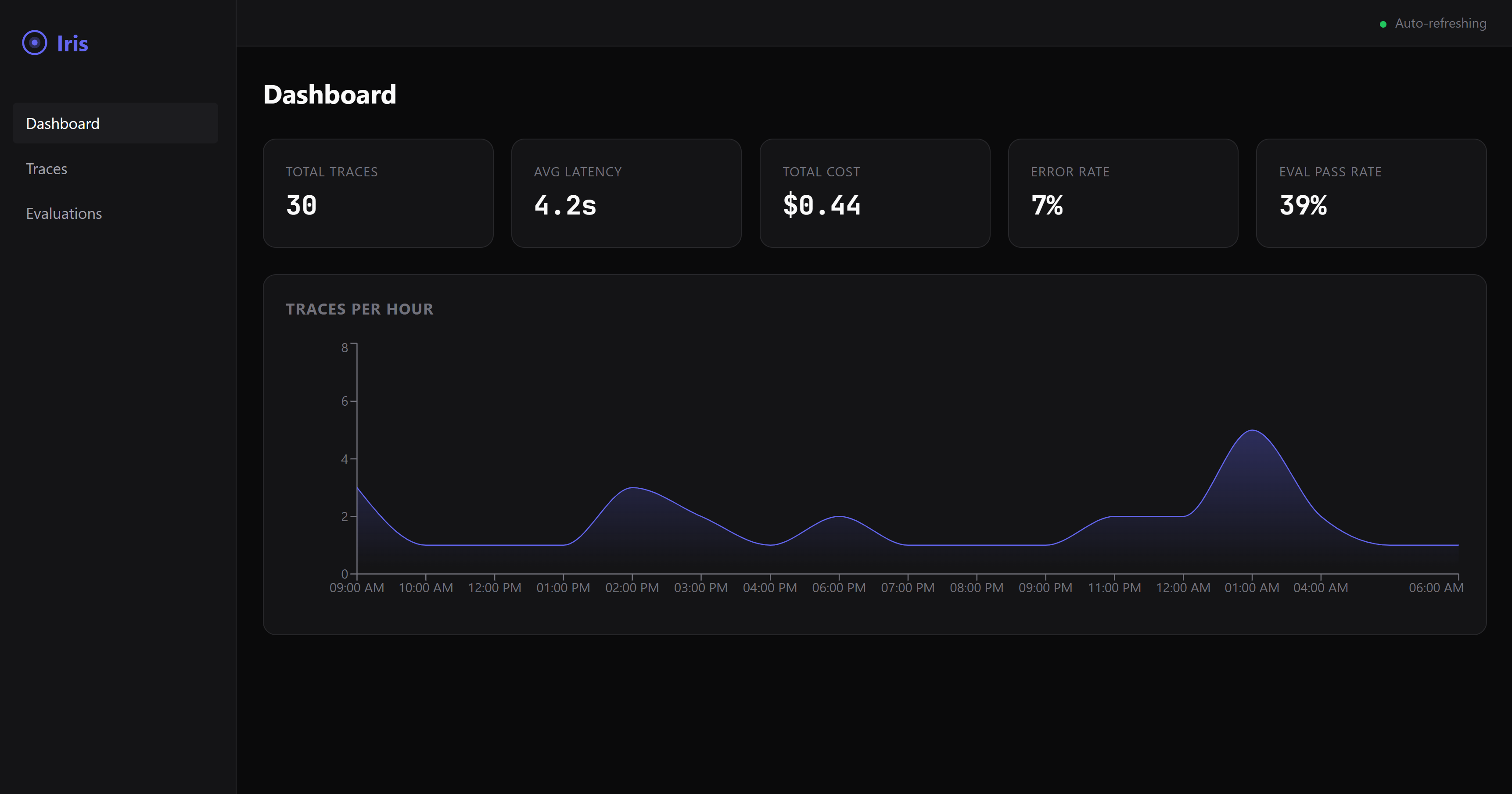
| Web Dashboard | Real-time dark-mode UI with trace visualization, eval results, and cost breakdowns. |
Quickstart
Add Iris to your Claude Desktop (or Cursor, Claude Code, Windsurf) MCP config:
{
  "mcpServers": {
    "iris-eval": {
      "command": "npx",
      "args": ["@iris-eval/mcp-server"]
    }
  }
}
That's it. Your agent discovers Iris and starts logging traces automatically.
Want the dashboard?
npx @iris-eval/mcp-server --dashboard
# Open http://localhost:6920
Other Install Methods
# Global install
npm install -g @iris-eval/mcp-server
iris-mcp --dashboard

# Docker
docker run -p 3000:3000 -v iris-data:/data ghcr.io/iris-eval/mcp-server
MCP Tools
Iris registers three tools that any MCP-compatible agent can invoke:
log_trace— Log an agent execution with spans, tool calls, token usage, and costevaluate_output— Score output quality against completeness, relevance, safety, and cost rulesget_traces— Query stored traces with filtering, pagination, and time-range support
Full tool schemas and configuration: iris-eval.com
Cloud Tier (Coming Soon)
Self-hosted Iris runs on your machine with SQLite. As your team grows, the cloud tier adds PostgreSQL, team dashboards, alerting, and managed infrastructure.
Join the waitlist to get early access.
Examples
- Claude Desktop setup — MCP config for stdio and HTTP modes
- TypeScript — MCP SDK client usage
- LangChain — Agent instrumentation
- CrewAI — Crew observability
Community
- GitHub Issues — Bug reports and feature requests
- GitHub Discussions — Questions and ideas
- Contributing Guide — How to contribute
- Roadmap — What's coming next
<details> <summary><strong>Configuration & Security</strong></summary>
CLI Arguments
| Flag | Default | Description |
|---|---|---|
--transport |
stdio |
Transport type: stdio or http |
--port |
3000 |
HTTP transport port |
--db-path |
~/.iris/iris.db |
SQLite database path |
--config |
~/.iris/config.json |
Config file path |
--api-key |
— | API key for HTTP authentication |
--dashboard |
false |
Enable web dashboard |
--dashboard-port |
6920 |
Dashboard port |
Environment Variables
| Variable | Description |
|---|---|
IRIS_TRANSPORT |
Transport type |
IRIS_PORT |
HTTP port |
IRIS_DB_PATH |
Database path |
IRIS_LOG_LEVEL |
Log level: debug, info, warn, error |
IRIS_DASHBOARD |
Enable dashboard (true/false) |
IRIS_API_KEY |
API key for HTTP authentication |
IRIS_ALLOWED_ORIGINS |
Comma-separated allowed CORS origins |
Security
When using HTTP transport, Iris includes:
- API key authentication with timing-safe comparison
- CORS restricted to localhost by default
- Rate limiting (100 req/min API, 20 req/min MCP)
- Helmet security headers
- Zod input validation on all routes
- ReDoS-safe regex for custom eval rules
- 1MB request body limits
# Production deployment
iris-mcp --transport http --port 3000 --api-key "$(openssl rand -hex 32)" --dashboard
</details>
If Iris is useful to you, consider starring the repo — it helps others find it.
MIT Licensed.
Recommended Servers

playwright-mcp
A Model Context Protocol server that enables LLMs to interact with web pages through structured accessibility snapshots without requiring vision models or screenshots.

Magic Component Platform (MCP)
An AI-powered tool that generates modern UI components from natural language descriptions, integrating with popular IDEs to streamline UI development workflow.

Audiense Insights MCP Server
Enables interaction with Audiense Insights accounts via the Model Context Protocol, facilitating the extraction and analysis of marketing insights and audience data including demographics, behavior, and influencer engagement.

VeyraX MCP
Single MCP tool to connect all your favorite tools: Gmail, Calendar and 40 more.

graphlit-mcp-server
The Model Context Protocol (MCP) Server enables integration between MCP clients and the Graphlit service. Ingest anything from Slack to Gmail to podcast feeds, in addition to web crawling, into a Graphlit project - and then retrieve relevant contents from the MCP client.

Kagi MCP Server
An MCP server that integrates Kagi search capabilities with Claude AI, enabling Claude to perform real-time web searches when answering questions that require up-to-date information.

Neon Database
MCP server for interacting with Neon Management API and databases

E2B
Using MCP to run code via e2b.

Exa Search
A Model Context Protocol (MCP) server lets AI assistants like Claude use the Exa AI Search API for web searches. This setup allows AI models to get real-time web information in a safe and controlled way.

Qdrant Server
This repository is an example of how to create a MCP server for Qdrant, a vector search engine.