
IDA Pro MCP
Enables AI-assisted reverse engineering in IDA Pro by providing tools to analyze binaries, decompile functions, manage comments, search patterns, and interact with the IDA database through natural language.
README
IDA Pro MCP
Simple MCP Server to allow vibe reversing in IDA Pro.
https://github.com/user-attachments/assets/6ebeaa92-a9db-43fa-b756-eececce2aca0
The binaries and prompt for the video are available in the mcp-reversing-dataset repository.
New in v1.6.0
- Dynamic Database Loading: Start headless server without a binary, load/switch files on demand
- Database Persistence: Save analysis to disk with
save_database() - Byte Pattern Search: Find hex patterns with wildcards using
search_bytes() - Comment Management: Full support for regular, repeatable, anterior, posterior, and function comments
- Control Flow Graphs: Analyze function structure with
get_function_cfg() - Script Execution: Run arbitrary IDAPython code via
execute_script()
Available functionality:
check_connection(): Check if the IDA plugin is running.get_metadata(): Get metadata about the current IDB.get_function_by_name(name): Get a function by its name.get_function_by_address(address): Get a function by its address.get_current_address(): Get the address currently selected by the user.get_current_function(): Get the function currently selected by the user.convert_number(text, size): Convert a number (decimal, hexadecimal) to different representations.list_functions_filter(offset, count, filter): List matching functions in the database (paginated, filtered).list_functions(offset, count): List all functions in the database (paginated).list_globals_filter(offset, count, filter): List matching globals in the database (paginated, filtered).list_globals(offset, count): List all globals in the database (paginated).list_imports(offset, count): List all imported symbols with their name and module (paginated).list_strings_filter(offset, count, filter): List matching strings in the database (paginated, filtered).list_strings(offset, count): List all strings in the database (paginated).list_segments(): List all segments in the binary.list_local_types(): List all Local types in the database.decompile_function(address): Decompile a function at the given address.disassemble_function(start_address): Get assembly code for a function (API-compatible with older IDA builds).get_xrefs_to(address): Get all cross references to the given address.get_xrefs_to_field(struct_name, field_name): Get all cross references to a named struct field (member).get_callees(function_address): Get all the functions called (callees) by the function at function_address.get_callers(function_address): Get all callers of the given address.get_entry_points(): Get all entry points in the database.set_comment(address, comment): Set a comment for a given address in the function disassembly and pseudocode.rename_local_variable(function_address, old_name, new_name): Rename a local variable in a function.rename_global_variable(old_name, new_name): Rename a global variable.set_global_variable_type(variable_name, new_type): Set a global variable's type.patch_address_assembles(address, instructions): <no description>.get_global_variable_value_by_name(variable_name): Read a global variable's value (if known at compile-time).get_global_variable_value_at_address(address): Read a global variable's value by its address (if known at compile-time).rename_function(function_address, new_name): Rename a function.set_function_prototype(function_address, prototype): Set a function's prototype.declare_c_type(c_declaration): Create or update a local type from a C declaration.set_local_variable_type(function_address, variable_name, new_type): Set a local variable's type.get_stack_frame_variables(function_address): Retrieve the stack frame variables for a given function.get_defined_structures(): Returns a list of all defined structures.analyze_struct_detailed(name): Detailed analysis of a structure with all fields.get_struct_at_address(address, struct_name): Get structure field values at a specific address.get_struct_info_simple(name): Simple function to get basic structure information.search_structures(filter): Search for structures by name pattern.rename_stack_frame_variable(function_address, old_name, new_name): Change the name of a stack variable for an IDA function.create_stack_frame_variable(function_address, offset, variable_name, type_name): For a given function, create a stack variable at an offset and with a specific type.set_stack_frame_variable_type(function_address, variable_name, type_name): For a given disassembled function, set the type of a stack variable.delete_stack_frame_variable(function_address, variable_name): Delete the named stack variable for a given function.read_memory_bytes(memory_address, size): Read bytes at a given address.data_read_byte(address): Read the 1 byte value at the specified address.data_read_word(address): Read the 2 byte value at the specified address as a WORD.data_read_dword(address): Read the 4 byte value at the specified address as a DWORD.data_read_qword(address): Read the 8 byte value at the specified address as a QWORD.data_read_string(address): Read the string at the specified address.search_bytes(pattern, start_address, max_results): Search for byte patterns with wildcards (e.g., "48 8B ?? ?? ?? ?? 00").get_comments(address): Get all comments at an address (regular, repeatable, anterior, posterior, function).add_comment(address, comment, comment_type): Add a comment at an address.delete_comment(address, comment_type): Delete a comment at an address.get_function_cfg(address): Get control flow graph with basic blocks, successors, and predecessors.execute_script(code, timeout_seconds): Execute arbitrary IDAPython code with access to all IDA modules.
Headless server tools (idalib-mcp only):
load_database(path, run_auto_analysis): Load a binary file or IDB for analysis.close_database(): Close the currently open database.save_database(path): Save the current database to disk (preserves all analysis).get_database_status(): Check if a database is loaded and get its path.
Unsafe functions (--unsafe flag required):
dbg_get_registers(): Get all registers and their values. This function is only available when debugging.dbg_get_registers_for_thread(thread_id): Get registers and their values for a specific thread.dbg_get_registers_for_thread_current(): Get registers for the thread currently paused in the debugger (top of the call stack).dbg_get_registers_general_for_thread(thread_id): Get general-purpose registers and their values for a specific thread.dbg_get_registers_general_for_thread_current(): Get general-purpose registers for the thread currently paused in the debugger.dbg_get_registers_specific_for_thread(thread_id, register_names): Get specific registers and their values for a given thread.dbg_get_registers_specific_for_thread_current(register_names): Get specific registers for the thread currently paused in the debugger.dbg_get_call_stack(): Get the current call stack.dbg_list_breakpoints(): List all breakpoints in the program.dbg_start_process(): Start the debugger, returns the current instruction pointer.dbg_exit_process(): Exit the debugger.dbg_continue_process(): Continue the debugger, returns the current instruction pointer.dbg_run_to(address): Run the debugger to the specified address.dbg_set_breakpoint(address): Set a breakpoint at the specified address.dbg_step_into(): Step into the current instruction.dbg_step_over(): Step over the current instruction.dbg_delete_breakpoint(address): Delete a breakpoint at the specified address.dbg_enable_breakpoint(address, enable): Enable or disable a breakpoint at the specified address.
Prerequisites
- Python (3.11 or higher)
- Use
idapyswitchto switch to the newest Python version
- Use
- IDA Pro (8.3 or higher, 9 recommended), IDA Free is not supported
- Supported MCP Client (pick one you like)
- Cline
- Roo Code
- Claude
- Cursor
- VSCode Agent Mode
- Windsurf
- Other MCP Clients: Run
ida-pro-mcp --configto get the JSON config for your client.
Installation
Install the latest version of the IDA Pro MCP package:
pip uninstall ida-pro-mcp
pip install https://github.com/icryo/ida-pro-mcp/archive/refs/heads/main.zip
Configure the MCP servers and install the IDA Plugin:
ida-pro-mcp --install
Important: Make sure you completely restart IDA/Visual Studio Code/Claude for the installation to take effect. Claude runs in the background and you need to quit it from the tray icon.
https://github.com/user-attachments/assets/65ed3373-a187-4dd5-a807-425dca1d8ee9
Note: You need to load a binary in IDA before the plugin menu will show up.
Prompt Engineering
LLMs are prone to hallucinations and you need to be specific with your prompting. For reverse engineering the conversion between integers and bytes are especially problematic. Below is a minimal example prompt, feel free to start a discussion or open an issue if you have good results with a different prompt:
Your task is to analyze a crackme in IDA Pro. You can use the MCP tools to retrieve information. In general use the following strategy:
- Inspect the decompilation and add comments with your findings
- Rename variables to more sensible names
- Change the variable and argument types if necessary (especially pointer and array types)
- Change function names to be more descriptive
- If more details are necessary, disassemble the function and add comments with your findings
- NEVER convert number bases yourself. Use the convert_number MCP tool if needed!
- Do not attempt brute forcing, derive any solutions purely from the disassembly and simple python scripts
- Create a report.md with your findings and steps taken at the end
- When you find a solution, prompt to user for feedback with the password you found
This prompt was just the first experiment, please share if you found ways to improve the output!
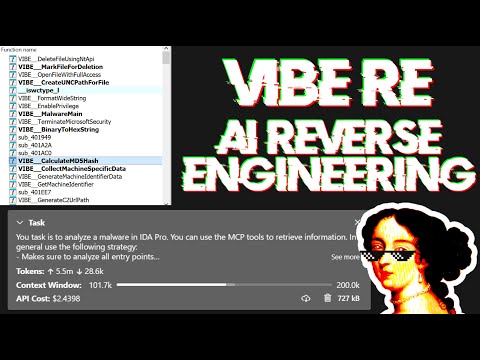
Live stream discussing prompting and showing some real-world malware analysis:
Tips for Enhancing LLM Accuracy
Large Language Models (LLMs) are powerful tools, but they can sometimes struggle with complex mathematical calculations or exhibit "hallucinations" (making up facts). Make sure to tell the LLM to use the conver_number MCP and you might also need math-mcp for certain operations.
Another thing to keep in mind is that LLMs will not perform well on obfuscated code. Before trying to use an LLM to solve the problem, take a look around the binary and spend some time (automatically) removing the following things:
- String encryption
- Import hashing
- Control flow flattening
- Code encryption
- Anti-decompilation tricks
You should also use a tool like Lumina or FLIRT to try and resolve all the open source library code and the C++ STL, this will further improve the accuracy.
SSE Transport & Headless MCP
You can run an SSE server to connect to the user interface like this:
uv run ida-pro-mcp --transport http://127.0.0.1:8744/sse
After installing idalib you can also run a headless SSE server:
# Start with a specific binary (backwards compatible)
uv run idalib-mcp --host 127.0.0.1 --port 8745 path/to/executable

# Or start without a binary (new in v1.6.0)
uv run idalib-mcp --host 127.0.0.1 --port 8745
Dynamic Database Loading (v1.6.0)
The headless server now supports loading and switching binaries dynamically:
# Start server without a binary
# uv run idalib-mcp --port 8745

# Then via MCP tools:
load_database("/path/to/malware.exe")           # Load binary
# ... analyze, rename functions, add comments ...
save_database()                                   # Save to malware.i64
save_database("/backups/malware_v1.i64")        # Create backup

load_database("/path/to/other.dll")             # Switch to another binary
get_database_status()                            # Check current state
close_database()                                  # Close without opening another
This enables:
- Analyzing multiple binaries in one session
- Creating analysis snapshots before risky operations
- Persisting analysis between sessions
- Team sharing of analyzed IDB files
Note: The original idalib feature was contributed by Willi Ballenthin.
Manual Installation
Note: This section is for LLMs and power users who need detailed installation instructions.
<details>
Manual MCP Server Installation (Cline/Roo Code)
To install the MCP server yourself, follow these steps:
- Install uv globally:
- Windows:
pip install uv - Linux/Mac:
curl -LsSf https://astral.sh/uv/install.sh | sh
- Windows:
- Clone this repository, for this example
C:\MCP\ida-pro-mcp. - Navigate to the Cline/Roo Code MCP Servers configuration (see screenshot).
- Click on the Installed tab.
- Click on Configure MCP Servers, which will open
cline_mcp_settings.json. - Add the
ida-pro-mcpserver:
{
  "mcpServers": {
    "github.com/icryo/ida-pro-mcp": {
      "command": "uv",
      "args": [
        "--directory",
        "c:\\MCP\\ida-pro-mcp",
        "run",
        "server.py",
        "--install-plugin"
      ],
      "timeout": 1800,
      "disabled": false
    }
  }
}
To check if the connection works you can perform the following tool call:
<use_mcp_tool>
<server_name>github.com/icryo/ida-pro-mcp</server_name>
<tool_name>check_connection</tool_name>
<arguments></arguments>
</use_mcp_tool>
IDA Plugin installation
The IDA Pro plugin will be installed automatically when the MCP server starts. If you disabled the --install-plugin option, use the following steps:
- Copy (not move)
src/ida_pro_mcp/mcp-plugin.pyin your plugins folder (%appdata%\Hex-Rays\IDA Pro\pluginson Windows). - Open an IDB and click
Edit -> Plugins -> MCPto start the server.
</details>
Comparison with other MCP servers
There are a few IDA Pro MCP servers floating around, but I created my own for a few reasons:
- Installation should be fully automated.
- The architecture of other plugins make it difficult to add new functionality quickly (too much boilerplate of unnecessary dependencies).
- Learning new technologies is fun!
If you want to check them out, here is a list (in the order I discovered them):
- https://github.com/taida957789/ida-mcp-server-plugin (SSE protocol only, requires installing dependencies in IDAPython).
- https://github.com/fdrechsler/mcp-server-idapro (MCP Server in TypeScript, excessive boilerplate required to add new functionality).
- https://github.com/MxIris-Reverse-Engineering/ida-mcp-server (custom socket protocol, boilerplate).
Feel free to open a PR to add your IDA Pro MCP server here.
Development
Adding new features is a super easy and streamlined process. All you have to do is add a new @jsonrpc function to mcp-plugin.py and your function will be available in the MCP server without any additional boilerplate! Below is a video where I add the get_metadata function in less than 2 minutes (including testing):
https://github.com/user-attachments/assets/951de823-88ea-4235-adcb-9257e316ae64
To test the MCP server itself:
uv run mcp dev src/ida_pro_mcp/server.py
This will open a web interface at http://localhost:5173 and allow you to interact with the MCP tools for testing.
For testing I create a symbolic link to the IDA plugin and then POST a JSON-RPC request directly to http://localhost:13337/mcp. After enabling symbolic links you can run the following command:
uv run ida-pro-mcp --install
Generate the changelog of direct commits to main:
git log --first-parent --no-merges 1.2.0..main "--pretty=- %s"
Recommended Servers

playwright-mcp
A Model Context Protocol server that enables LLMs to interact with web pages through structured accessibility snapshots without requiring vision models or screenshots.

Magic Component Platform (MCP)
An AI-powered tool that generates modern UI components from natural language descriptions, integrating with popular IDEs to streamline UI development workflow.

Audiense Insights MCP Server
Enables interaction with Audiense Insights accounts via the Model Context Protocol, facilitating the extraction and analysis of marketing insights and audience data including demographics, behavior, and influencer engagement.

VeyraX MCP
Single MCP tool to connect all your favorite tools: Gmail, Calendar and 40 more.

graphlit-mcp-server
The Model Context Protocol (MCP) Server enables integration between MCP clients and the Graphlit service. Ingest anything from Slack to Gmail to podcast feeds, in addition to web crawling, into a Graphlit project - and then retrieve relevant contents from the MCP client.

Kagi MCP Server
An MCP server that integrates Kagi search capabilities with Claude AI, enabling Claude to perform real-time web searches when answering questions that require up-to-date information.

E2B
Using MCP to run code via e2b.

Neon Database
MCP server for interacting with Neon Management API and databases

Exa Search
A Model Context Protocol (MCP) server lets AI assistants like Claude use the Exa AI Search API for web searches. This setup allows AI models to get real-time web information in a safe and controlled way.

Qdrant Server
This repository is an example of how to create a MCP server for Qdrant, a vector search engine.