
figma-mcp-go
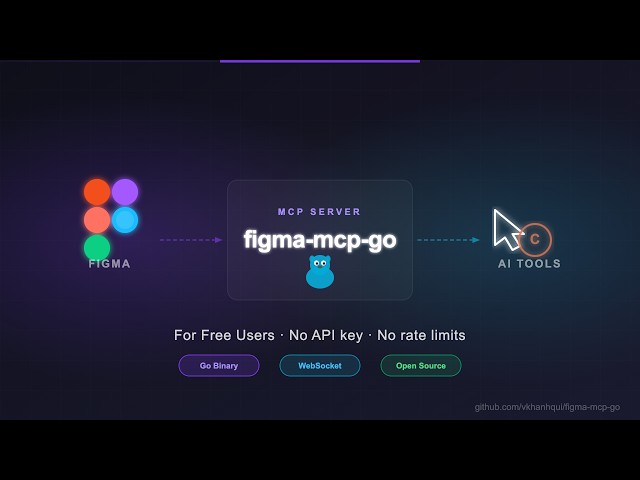
Figma MCP server with full read/write access via plugin bridge — no API token, no rate limits. 58 tools for design automation: styles, variables, components, prototypes, and content.
README
figma-mcp-go
Figma MCP — Free, No Rate Limits
Open-source Figma MCP server with full read/write access via plugin — no REST API, no rate limits. Turn text into designs and designs into real code. Works with Cursor, Claude, GitHub Copilot, and any MCP-compatible AI tool.
Highlights
- No Figma API token required
- No rate limits — free plan friendly
- Read and Write live Figma data via plugin bridge — 58 tools total
- Full design automation — styles, variables, components, prototypes, and content
- Design strategies included — read_design_strategy, design_strategy, and more prompts built in
https://github.com/user-attachments/assets/17bda971-0e83-4f18-8758-8ac2b8dcba62
Why this exists
Most Figma MCP servers rely on the Figma REST API.
That sounds fine… until you hit this:
| Plan | Limit |
|---|---|
| Starter / View / Collab | 6 tool calls/month |
| Pro / Org (Dev seat) | 200 tool calls/day |
| Enterprise | 600 tool calls/day |
If you're experimenting with AI tools, you'll burn through that in minutes.
I didn't have enough money to pay for higher limits. So I built something that doesn't use the API at all.
Installation & Setup
Install via npx — no build step required. Watch the setup video or follow the steps below.
1. Configure your AI tool
Claude Code CLI
claude mcp add -s project figma-mcp-go -- npx -y @vkhanhqui/figma-mcp-go@latest
.mcp.json (Claude and other MCP-compatible tools)
{
  "mcpServers": {
    "figma-mcp-go": {
      "command": "npx",
      "args": ["-y", "@vkhanhqui/figma-mcp-go"]
    }
  }
}
.vscode/mcp.json (Cursor / VS Code / GitHub Copilot)
{
  "servers": {
    "figma-mcp-go": {
      "type": "stdio",
      "command": "npx",
      "args": [
        "-y",
        "@vkhanhqui/figma-mcp-go"
      ]
    }
  }
}
2. Install the Figma plugin
- In Figma Desktop: Plugins → Development → Import plugin from manifest
- Select
manifest.jsonfrom the plugin.zip - Run the plugin inside any Figma file
Available Tools
Write — Create
| Tool | Description |
|---|---|
create_frame |
Create a frame with optional auto-layout, fill, and parent |
create_rectangle |
Create a rectangle with optional fill and corner radius |
create_ellipse |
Create an ellipse or circle |
create_text |
Create a text node (font loaded automatically) |
import_image |
Decode base64 image and place it as a rectangle fill |
create_component |
Convert an existing FRAME node into a reusable component |
Write — Modify
| Tool | Description |
|---|---|
set_text |
Update text content of an existing TEXT node |
set_fills |
Set solid fill color (hex) on a node |
set_strokes |
Set solid stroke color and weight on a node |
set_opacity |
Set opacity of one or more nodes (0 = transparent, 1 = opaque) |
set_corner_radius |
Set corner radius — uniform or per-corner |
set_auto_layout |
Set or update auto-layout (flex) properties on a frame |
move_nodes |
Move nodes to an absolute x/y position |
resize_nodes |
Resize nodes by width and/or height |
rename_node |
Rename a node |
clone_node |
Clone a node, optionally repositioning or reparenting |
Write — Delete
| Tool | Description |
|---|---|
delete_nodes |
Delete one or more nodes permanently |
Write — Prototype
| Tool | Description |
|---|---|
set_reactions |
Set prototype reactions (triggers + actions) on a node; mode replace or append |
remove_reactions |
Remove all or specific reactions by zero-based index from a node |
Write — Styles
| Tool | Description |
|---|---|
create_paint_style |
Create a named paint style with a solid color |
create_text_style |
Create a named text style with font, size, and spacing |
create_effect_style |
Create a named effect style (drop shadow, inner shadow, blur) |
create_grid_style |
Create a named layout grid style (columns, rows, or grid) |
update_paint_style |
Rename or recolor an existing paint style |
apply_style_to_node |
Apply an existing local style to a node, linking it to that style |
delete_style |
Delete any style (paint, text, effect, or grid) by ID |
Write — Variables
| Tool | Description |
|---|---|
create_variable_collection |
Create a new local variable collection with an optional initial mode |
add_variable_mode |
Add a new mode to an existing collection (e.g. Light/Dark) |
create_variable |
Create a variable (COLOR/FLOAT/STRING/BOOLEAN) in a collection |
set_variable_value |
Set a variable's value for a specific mode |
bind_variable_to_node |
Bind a local variable to a node property |
delete_variable |
Delete a variable or an entire collection |
Write — Components & Navigation
| Tool | Description |
|---|---|
navigate_to_page |
Switch the active Figma page by ID or name |
group_nodes |
Group two or more nodes into a GROUP |
ungroup_nodes |
Ungroup GROUP nodes, moving children to the parent |
swap_component |
Swap the main component of an INSTANCE node |
detach_instance |
Detach component instances, converting them to plain frames |
Read — Document & Selection
| Tool | Description |
|---|---|
get_document |
Full current page tree |
get_metadata |
File name, pages, current page |
get_pages |
All pages (IDs + names) — lightweight, no tree loading |
get_selection |
Currently selected nodes |
get_node |
Single node by ID |
get_nodes_info |
Multiple nodes by ID |
get_design_context |
Depth-limited tree with detail level (minimal/compact/full) |
search_nodes |
Find nodes by name substring and/or type within a subtree |
scan_text_nodes |
All text nodes in a subtree |
scan_nodes_by_types |
Nodes matching given type list |
get_viewport |
Current viewport center, zoom, and visible bounds |
Read — Styles & Variables
| Tool | Description |
|---|---|
get_styles |
Paint, text, effect, and grid styles |
get_variable_defs |
Variable collections and values |
get_local_components |
All components + component sets with variant properties |
get_annotations |
Dev-mode annotations |
get_fonts |
All fonts used on the current page, sorted by frequency |
get_reactions |
Prototype/interaction reactions on a node |
Export
| Tool | Description |
|---|---|
get_screenshot |
Base64 image export of any node |
save_screenshots |
Export images to disk (server-side, no API call) |
export_frames_to_pdf |
Export multiple frames as a single multi-page PDF file saved to disk |
export_tokens |
Export design tokens (variables + paint styles) as JSON or CSS |
MCP Prompts
| Prompt | Description |
|---|---|
read_design_strategy |
Best practices for reading Figma designs |
design_strategy |
Best practices for creating and modifying designs |
text_replacement_strategy |
Chunked approach for replacing text across a design |
annotation_conversion_strategy |
Convert manual annotations to native Figma annotations |
swap_overrides_instances |
Transfer overrides between component instances |
reaction_to_connector_strategy |
Map prototype reactions into interaction flow diagrams |
Related Projects
Contributing
Issues and PRs are welcome.
Star History
<a href="https://www.star-history.com/?repos=vkhanhqui%2Ffigma-mcp-go&type=date&legend=top-left"> <picture> <source media="(prefers-color-scheme: dark)" srcset="https://api.star-history.com/chart?repos=vkhanhqui/figma-mcp-go&type=date&theme=dark&legend=top-left" /> <source media="(prefers-color-scheme: light)" srcset="https://api.star-history.com/chart?repos=vkhanhqui/figma-mcp-go&type=date&legend=top-left" /> <img alt="Star History Chart" src="https://api.star-history.com/chart?repos=vkhanhqui/figma-mcp-go&type=date&legend=top-left" /> </picture> </a>
Recommended Servers

playwright-mcp
A Model Context Protocol server that enables LLMs to interact with web pages through structured accessibility snapshots without requiring vision models or screenshots.

Magic Component Platform (MCP)
An AI-powered tool that generates modern UI components from natural language descriptions, integrating with popular IDEs to streamline UI development workflow.

Audiense Insights MCP Server
Enables interaction with Audiense Insights accounts via the Model Context Protocol, facilitating the extraction and analysis of marketing insights and audience data including demographics, behavior, and influencer engagement.

VeyraX MCP
Single MCP tool to connect all your favorite tools: Gmail, Calendar and 40 more.

graphlit-mcp-server
The Model Context Protocol (MCP) Server enables integration between MCP clients and the Graphlit service. Ingest anything from Slack to Gmail to podcast feeds, in addition to web crawling, into a Graphlit project - and then retrieve relevant contents from the MCP client.

Kagi MCP Server
An MCP server that integrates Kagi search capabilities with Claude AI, enabling Claude to perform real-time web searches when answering questions that require up-to-date information.

E2B
Using MCP to run code via e2b.

Neon Database
MCP server for interacting with Neon Management API and databases

Exa Search
A Model Context Protocol (MCP) server lets AI assistants like Claude use the Exa AI Search API for web searches. This setup allows AI models to get real-time web information in a safe and controlled way.

Qdrant Server
This repository is an example of how to create a MCP server for Qdrant, a vector search engine.