
EyeBrowse
Enables LLMs to drive a stealthy, fingerprint-spoofed Firefox browser via MCP tools, supporting navigation, interaction, extraction, and multi-session management.
README
<div align="center">
🦊 EyeBrowse
A stealthy, LLM-drivable browser engine — one codebase, two faces.
A Python library and an MCP server for driving a real, hard-to-detect browser — Camoufox, a Firefox fork with C++-level fingerprint spoofing — so legitimate automation isn't false-flagged or IP-banned by Cloudflare, DataDome, Akamai, or PerimeterX.




-FF6611.svg)
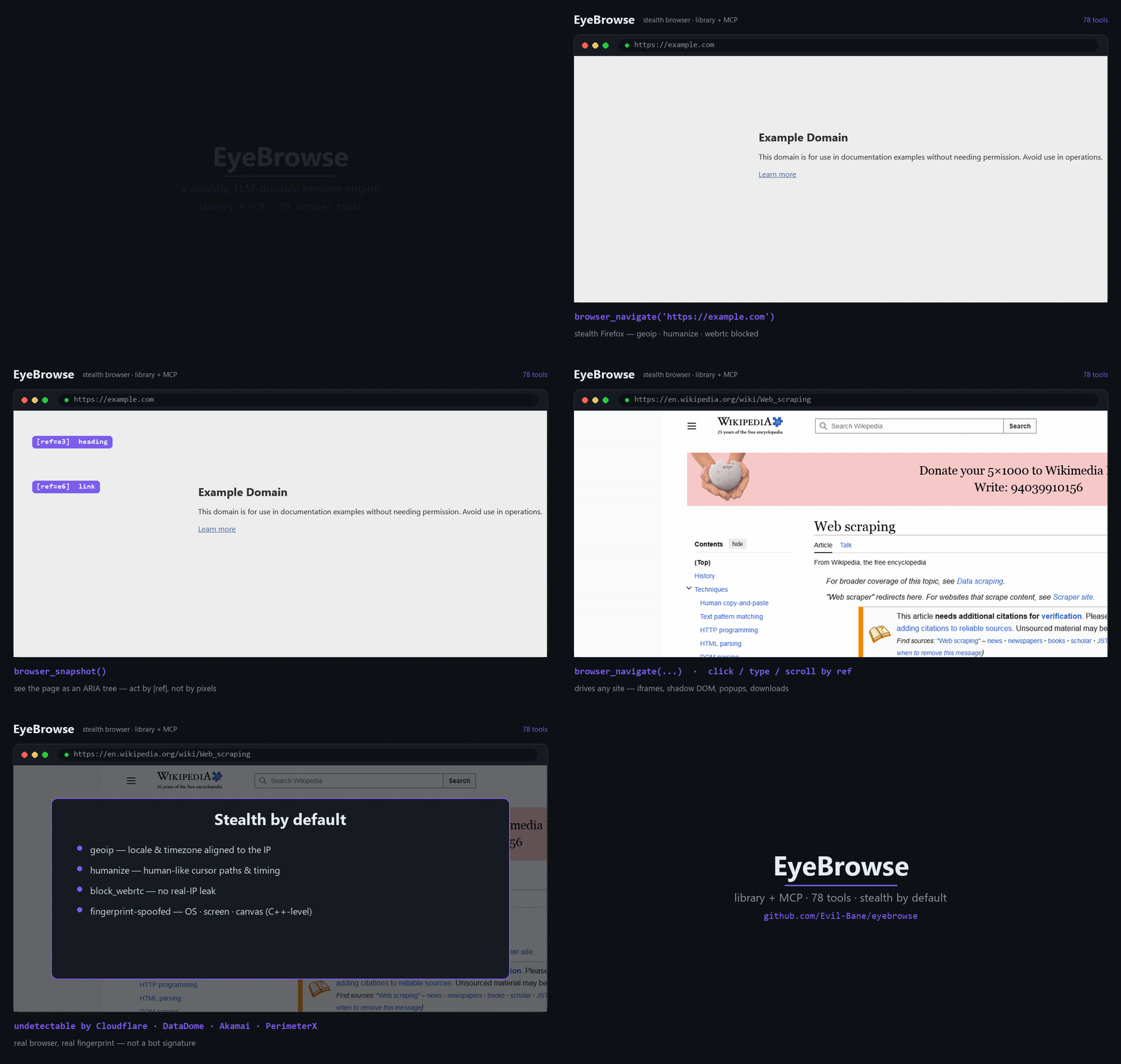
<sub>▶ Higher-quality MP4: <a href="https://github.com/Evil-Bane/eyebrowse/blob/master/docs/demo.mp4">docs/demo.mp4</a> — real EyeBrowse captures, composed into an ad by <code>examples/make_demo.py</code></sub>
</div>
Why EyeBrowse?
- 🥷 Stealth by default — engine-level fingerprint spoofing (
geoip+humanize+block_webrtcon out of the box);navigator.webdrivermasked; viewport auto-sized to the spoofed screen. Nopuppeteer-extraband-aids — the anti-detection is in the browser. - 🤖 Built for LLMs — pages are read as an ARIA tree with
[ref=…]handles; the model acts by ref (click/type/hover), not by brittle CSS or raw pixels. Cross-origin iframes, shadow DOM, popups — handled. - 🧰 Library and MCP from one codebase — a clean Python API (
EyeBrowse+Session), mirrored 1:1 by a thin MCP server (78browser_*tools) for Claude Code and any MCP client. - 🪟 Never boxed in — the curated high-level API doesn't hide Playwright: reach
session.page/.context/.browserfor anything it doesn't wrap. - 🔋 Batteries included — multi-session, proxy + identity rotation, API-mode captcha solvers, full HAR capture, screen recording (MP4/GIF), and clean-markdown extraction.
Scope. EyeBrowse is a low-level browser engine — it holds no workflow logic. Consumers decide what to do; the engine provides what's possible.
Contents
Quickstart · Install · Features · Library · MCP · Proxy & identity · Extraction · Recording · How it works · Caveats · Tools · License
Quickstart
pip install eyebrowse
python -m camoufox fetch          # one-time: download the stealth Firefox + GeoIP db
import asyncio
from eyebrowse import EyeBrowse

async def main():
    eb = EyeBrowse()                          # stealth defaults: geoip · humanize · block_webrtc
    async with eb.session() as s:
        await s.navigate("https://example.com")
        print(await s.snapshot())             # ARIA tree with [ref=...] handles
        await s.click("e6")                   # act on a ref from the snapshot
    await eb.aclose()

asyncio.run(main())
…or wire it into Claude Code (or any MCP client) — see Use over MCP.
Install
From PyPI
pip install eyebrowse                 # or: uv pip install eyebrowse
python -m camoufox fetch             # one-time browser fetch (like Playwright's `playwright install`)
pip install "eyebrowse[extract]"     # optional: + Crawl4AI markdown extraction (heavier)
From source (development)
git clone https://github.com/Evil-Bane/eyebrowse && cd eyebrowse
uv sync                              # core engine  (add --extra extract for Crawl4AI)
uv run python -m camoufox fetch
cp .env.example .env                 # only if you use a proxy / captcha keys
Python 3.12 (pinned <3.13). Pinned engine: camoufox==0.4.11 (Firefox v135), playwright 1.60, mcp 1.27.
Features
| 🥷 Stealth | Camoufox engine-level fingerprint spoofing; geoip + humanize + block_webrtc by default; webdriver masked; viewport matched to the spoofed screen. |
| 🤖 LLM interaction | aria_snapshot(mode="ai") → ARIA tree + [ref] handles; click / type / hover / select / drag / file-upload / dialogs / keyboard; coordinate mouse too. |
| 🪟 Frames & DOM | cross-origin iframe routing by ref, shadow-DOM piercing, popup/new-tab switching, evaluate inside any frame. |
| 🗂 Multi-session | independent stealth sessions, each with its own context / identity / proxy. |
| 🌐 Network | inspect requests/responses (incl. XHR/fetch bodies & WebSocket frames), block URLs, mock responses, go offline, full HAR export. |
| 💾 State | cookies, localStorage & sessionStorage (CRUD), storage_state save/reload. |
| 🪪 Identity rotation | fresh fingerprint (OS/screen) + isolated profile + paired proxy; pluggable residential ProxyProvider. |
| 🧩 Captcha | pluggable API-mode solvers (CapSolver / 2Captcha / CapMonster / NextCaptcha) + TOTP — no browser extension. |
| 📄 Extraction | Crawl4AI raw: feed → clean, token-efficient markdown (no LLM, no API keys). |
| 🎥 Capture | screenshots, Playwright tracing, and screen recording → MP4 / WebM / GIF (ffmpeg). |
| ✅ Verify & debug | assertions, element highlighting, locator generation, geolocation/header emulation. |
Full per-tool reference: docs/TOOLS.md (78 tools across 17 groups).
Use as a library
import asyncio
from eyebrowse import EyeBrowse

async def main():
    eb = EyeBrowse()                           # stealth defaults
    try:
        async with eb.session() as s:          # a stealth session (auto-closed)
            await s.navigate("https://example.com")
            print(await s.snapshot())          # ARIA tree with [ref=...] handles
            await s.click("e6")                # act on a ref
            await s.type("e8", "hello", submit=True)
            png = await s.screenshot(full_page=True)
            title = await s.page.title()        # full Playwright power when you need it
    finally:
        await eb.aclose()

asyncio.run(main())
Run the included proof: uv run python examples/direct_usage.py.
Use over MCP
EyeBrowse ships an MCP server (eyebrowse-mcp, FastMCP over stdio). Add it to any MCP client.
Claude Code (CLI):
claude mcp add eyebrowse -- eyebrowse-mcp
Any MCP client (JSON config):
{
  "mcpServers": {
    "eyebrowse": {
      "command": "eyebrowse-mcp"
    }
  }
}
Then drive the loop: browser_navigate(url) → read the snapshot → act by ref
(browser_click / browser_type / …). A default session is auto-created, so most tools just
work. Full list: docs/TOOLS.md.
Proxy & identity (optional)
Runs proxyless by default (geoip still aligns locale/timezone to your real IP). Add a proxy
only when you want one:
await eb.new_session(proxy="http://user:pass@residential.example:8080")
await eb.rotate_identity(proxy="socks5://host:1080")   # fresh fingerprint + paired IP
await eb.new_session(no_proxy=True)                     # force proxyless
Set a default once via EYEBROWSE_PROXY_* in .env, eb.set_static_proxy(...), or a custom
ProxyProvider for rotation. Over MCP: browser_new_session(proxy_url=…) /
browser_new_identity(proxy_url=…) / browser_set_proxy(…).
Extraction
eb.extract() (or browser_extract) hands the rendered HTML to Crawl4AI's raw: feed and
returns clean, pruned markdown — no LLM is called and no LLM keys are ever read; the
consuming agent does any structuring.
md  = await eb.extract()                            # markdown string
res = await eb.extract(output_path="data/page.md")  # → {"path": ..., "chars": ...}
Recording
Camoufox can't write native browser video, so EyeBrowse rolls its own recorder: it captures
viewport frames and encodes them with ffmpeg into a smooth, real-time MP4/WebM (and a
palette-optimized GIF that autoplays inline on GitHub). ffmpeg ships bundled
(imageio-ffmpeg), so it works out of the box.
await s.start_recording(fps=30)
# ... drive the browser ...
await s.stop_recording("demo.mp4", extra_paths=["demo.gif"])
The demo at the top was produced this way — see examples/make_demo.py.
How it works
CONSUMERS                         ENGINE (library: eyebrowse/)
 Claude Code  ──MCP──▶  mcp/  ──▶  EyeBrowse façade (public API)
 your code   ─ import ──────────▶   ├─ Camoufox engine (stealth context, HAR)
 any MCP client                     ├─ proxy / identity rotation (pluggable)
                                    ├─ captcha solvers (pluggable, API-mode)
                                    └─ Crawl4AI (raw: feed) → clean markdown
The façade (EyeBrowse + Session) is the product; the MCP adapter is a thin 1:1 wrapper over
it. The high-level API is curated and LLM-friendly — not a reimplementation of all of Playwright
— and the raw page / context / browser objects are always one attribute away.
Camoufox caveats
These shape the API — worth knowing:
evaluateruns in an isolated world — it sees the DOM but not page-scriptwindow.*globals. Read app state via DOM / network / HAR.- reload / back / forward aren't reported by Firefox's Juggler, so they're driven via
goto+ an internal navigate() history (they traverse navigate()-driven history, not click-driven). - Not available on Firefox/Camoufox (intentionally omitted, not broken):
page.pdf(), media emulation, and native Playwright video — use the ffmpeg recorder instead.
Project layout
eyebrowse/
  api.py            EyeBrowse façade — the single public entry point
  config.py         settings / secrets (pydantic-settings)
  snapshot.py       aria_snapshot(mode="ai") + aria-ref= resolution
  proxy.py          ProxyConfig + pluggable ProxyProvider
  identity.py       Identity + random_identity()
  extract.py        Crawl4AI raw: feed → markdown (lazy, optional dep)
  engine/           camoufox_engine.py (launch) + session.py (verbs + registry)
  captcha/          solver ABC + 4 providers + DOM detect/inject
  mcp/              FastMCP server + state + tools/ (17 groups, 78 tools)
examples/direct_usage.py   library proof (no MCP)
examples/make_demo.py      the screen-recording demo above
docs/TOOLS.md              full tool reference
Build notes, version-pin rationale, and verified Camoufox behavior live in CLAUDE.md.
Use responsibly
EyeBrowse drives a real browser with anti-detection features. Use it only against sites you own or are explicitly authorized to automate, and within their terms and applicable law.
License
MIT © Evil-Bane
Recommended Servers

playwright-mcp
A Model Context Protocol server that enables LLMs to interact with web pages through structured accessibility snapshots without requiring vision models or screenshots.

Magic Component Platform (MCP)
An AI-powered tool that generates modern UI components from natural language descriptions, integrating with popular IDEs to streamline UI development workflow.

Audiense Insights MCP Server
Enables interaction with Audiense Insights accounts via the Model Context Protocol, facilitating the extraction and analysis of marketing insights and audience data including demographics, behavior, and influencer engagement.

VeyraX MCP
Single MCP tool to connect all your favorite tools: Gmail, Calendar and 40 more.

graphlit-mcp-server
The Model Context Protocol (MCP) Server enables integration between MCP clients and the Graphlit service. Ingest anything from Slack to Gmail to podcast feeds, in addition to web crawling, into a Graphlit project - and then retrieve relevant contents from the MCP client.

Kagi MCP Server
An MCP server that integrates Kagi search capabilities with Claude AI, enabling Claude to perform real-time web searches when answering questions that require up-to-date information.

Neon Database
MCP server for interacting with Neon Management API and databases

E2B
Using MCP to run code via e2b.

Exa Search
A Model Context Protocol (MCP) server lets AI assistants like Claude use the Exa AI Search API for web searches. This setup allows AI models to get real-time web information in a safe and controlled way.

Qdrant Server
This repository is an example of how to create a MCP server for Qdrant, a vector search engine.