
Countersign
Kill switch + spend guard for AI agents that spend money: one policy, one sub-second freeze, and one signed audit ledger across every wallet vendor at once (Coinbase, Turnkey, Openfort + cards). Tools include a pre-flight request_spend guard, freeze, apply_policy, ledger, and x402/AP2 payment-mandate guards — free self-serve key, no account.
README
Countersign
A neutral, cross-vendor control plane for AI agents that spend money. Countersign holds the policy, the freeze, and the audit ledger across multiple agent-wallet backends at once — the one thing no single wallet vendor can do, because each only governs its own rail. That aggregation is the moat.
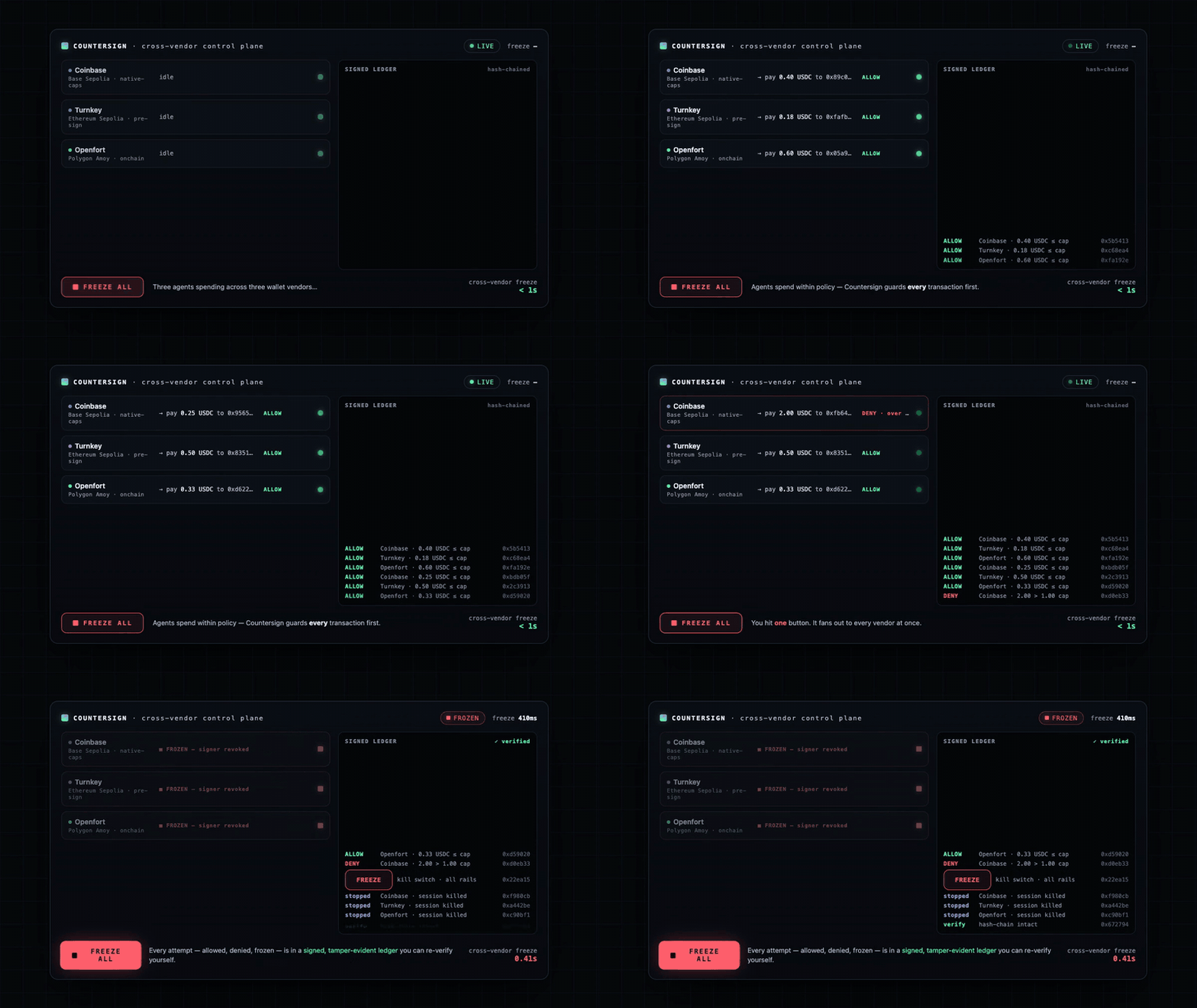
Live version of this loop: countersign.network/demo.html · 60s video
One falsifiable test defines it: can Countersign freeze agents across many backends at once, in under a second, with a unified tamper-evident ledger of every attempt? Proven LIVE across four rails (Coinbase, Turnkey, Openfort, and a Lithic Visa card) in ~432ms on testnet.
This repository is the open-core front door — the Apache-2.0 packages you build against: the integration contract, the typed client, the MCP tools, and the x402 guard. The control-plane "brain" (the policy compiler, the hash-chained ledger, the vendor adapters, and the hosted Core) is separate and proprietary; you reach it over the network via the SDK/MCP, hosted at app.countersign.network.
Quickstart
Drop the kill switch + spend guard into any MCP client (Claude, Cursor, …) — one line:
// claude / cursor mcp config
{ "mcpServers": { "countersign": {
  "command": "npx", "args": ["-y", "@countersign/mcp"],
  "env": { "COUNTERSIGN_URL": "https://app.countersign.network", "COUNTERSIGN_API_KEY": "csk_…" }
}}}
Or wire it into your own agent with the SDK:
import { CountersignClient } from "@countersign/sdk";
const cs = new CountersignClient({ baseUrl, apiKey });

await cs.evaluate({ agentId, amount, asset, venue }); // may this spend happen? (allow / deny / needs_approval)
await cs.freeze();                                     // the kill switch — every backend, < 1s
Get a free testnet key at https://app.countersign.network/start?ref=gh-readme.
Agents paying agents? See examples/guarded-payee — the A2A/AP2
pattern where a payee advertises it is governed and the payer verifies that (and guards its own
payment) before any mandate is signed.
Packages (this repo — all Apache-2.0)
| Package | Role |
|---|---|
@countersign/core |
the EnforcementProvider interface, branded ids, the unified policy schema, the fail-closed freeze controller — the integration contract every backend implements |
@countersign/api-contract |
OpenAPI + typed REST/ws schema — the single source of truth for the Client↔Core wire interface |
@countersign/sdk |
typed client over the Core API + live ledger subscribe |
@countersign/mcp |
Countersign as MCP tools — kill switch + spend guard inside any MCP client |
@countersign/x402 |
govern x402 (HTTP-402 machine payments) — guard a payment before it pays |
@countersign/verify |
verify a ledger entry offline — hash chain, RFC 6962 Merkle inclusion, Ed25519 signatures |
@countersign/ap2 |
govern AP2 (Agent Payments Protocol) — guard an agent-payment mandate before it executes |
The proprietary brain (policy compiler to each backend's native controls, ledger, Coinbase / Turnkey / Openfort / Lithic adapters, the hosted Core) lives in a separate private repository.
Prime directives (invariants)
- Don't build cryptography — integrate vendor MPC/TEE; session keys, never master keys.
- Build the layer above the wallets; cross-vendor aggregation is the product.
- Fail-closed: no decision / no backend response ⇒ the transaction does not execute.
- Backend-agnostic core; no vendor logic leaks past the
EnforcementProviderinterface. - Append-only, hash-chained ledger is the source of truth.
- Testnet only — mainnet follows a third-party security audit.
Links
- Home: https://countersign.network · Hosted Core: https://app.countersign.network
- npm:
@countersign/sdk·@countersign/mcp·@countersign/x402·@countersign/ap2 - Architecture:
docs/architecture.md· Security:SECURITY.md
Apache-2.0. Countersign holds policy, freeze, and a tamper-evident ledger — it never takes custody of funds.
Recommended Servers

playwright-mcp
A Model Context Protocol server that enables LLMs to interact with web pages through structured accessibility snapshots without requiring vision models or screenshots.

Magic Component Platform (MCP)
An AI-powered tool that generates modern UI components from natural language descriptions, integrating with popular IDEs to streamline UI development workflow.

Audiense Insights MCP Server
Enables interaction with Audiense Insights accounts via the Model Context Protocol, facilitating the extraction and analysis of marketing insights and audience data including demographics, behavior, and influencer engagement.

VeyraX MCP
Single MCP tool to connect all your favorite tools: Gmail, Calendar and 40 more.

graphlit-mcp-server
The Model Context Protocol (MCP) Server enables integration between MCP clients and the Graphlit service. Ingest anything from Slack to Gmail to podcast feeds, in addition to web crawling, into a Graphlit project - and then retrieve relevant contents from the MCP client.

Kagi MCP Server
An MCP server that integrates Kagi search capabilities with Claude AI, enabling Claude to perform real-time web searches when answering questions that require up-to-date information.

E2B
Using MCP to run code via e2b.

Neon Database
MCP server for interacting with Neon Management API and databases

Exa Search
A Model Context Protocol (MCP) server lets AI assistants like Claude use the Exa AI Search API for web searches. This setup allows AI models to get real-time web information in a safe and controlled way.

Qdrant Server
This repository is an example of how to create a MCP server for Qdrant, a vector search engine.